



🖊️ Post


☪︎ The Arab Spring Part 3 🇪🇬 Egypt: The Tahrir Square Revolution and the Turning Point of the Arab Spring


4
The Egyptian Revolution of 2011 became one of the most powerful and symbolic events of the Arab Spring.
For eighteen dramatic days in early 2011, millions of Egyptians filled streets and public squares demanding the end of a government that had ruled the country for nearly three decades.
The center of the uprising was Tahrir Square in Cairo, which became a global symbol of mass protest, civic resistance, and the struggle for political change.
The protests ultimately forced the resignation of President Hosni Mubarak, ending his thirty-year rule and marking one of the most dramatic political transformations in modern Middle Eastern history.
For supporters, the revolution represented a historic moment of popular empowerment and the possibility of democratic reform.
For critics, the events revealed how political instability, competing ideological factions, and geopolitical pressures could complicate revolutionary change.
Egypt’s revolution would reshape not only the country itself but also the broader trajectory of the Arab Spring.
Egypt Under Hosni Mubarak
To understand the Egyptian Revolution, it is important to examine the political system that existed before the uprising.
Hosni Mubarak became president of Egypt in 1981 after the assassination of President Anwar Sadat.
Over the following decades, Mubarak established a highly centralized political system.
His government relied heavily on:
• Strong security services
• Emergency laws that limited political freedoms
• Control over major media outlets
• Close alliances with the military establishment
Although Egypt held elections, critics argued that the political system offered limited opportunities for genuine opposition parties to compete for power.
Mubarak’s government also maintained strong relationships with Western governments and played a major role in regional diplomacy.
However, many Egyptians increasingly felt disconnected from the political system.
By the late 2000s, public frustration was growing across multiple sectors of society.
Economic Challenges and Public Frustration
One of the major drivers of the revolution was economic dissatisfaction.
Despite periods of economic growth, many Egyptians struggled with serious economic challenges.
These included:
• High unemployment, particularly among young people
• Rising food and fuel prices
• Widespread corruption
• Limited economic mobility
Egypt had one of the largest youth populations in the Middle East, with millions of young people entering the workforce each year.
Many educated young Egyptians found it difficult to secure stable employment.
At the same time, allegations of corruption within the political elite were widespread.
Many citizens believed that powerful political and business families controlled large portions of the economy.
These frustrations created a growing sense of economic injustice and political exclusion.
The Inspiration from Tunisia


4
The immediate catalyst for Egypt’s uprising came from events in Tunisia.
In January 2011, Tunisia’s long-time leader Zine El Abidine Ben Ali fled the country after weeks of mass protests.
The success of the Tunisian Revolution shocked governments across the region.
For many Egyptians, it demonstrated that long-standing authoritarian leaders could be removed through mass public protest.
Activists in Egypt began calling for demonstrations on January 25, 2011, which coincided with National Police Day.
The date was chosen deliberately as a protest against police brutality and government repression.
What began as a planned demonstration quickly turned into one of the largest protest movements in Egypt’s history.
The Rise of the Tahrir Square Movement


4
On January 25, thousands of Egyptians took to the streets in cities across the country.
Within days, the protests grew dramatically.
Large crowds gathered in Tahrir Square, located in central Cairo.
The square quickly became the focal point of the revolution.
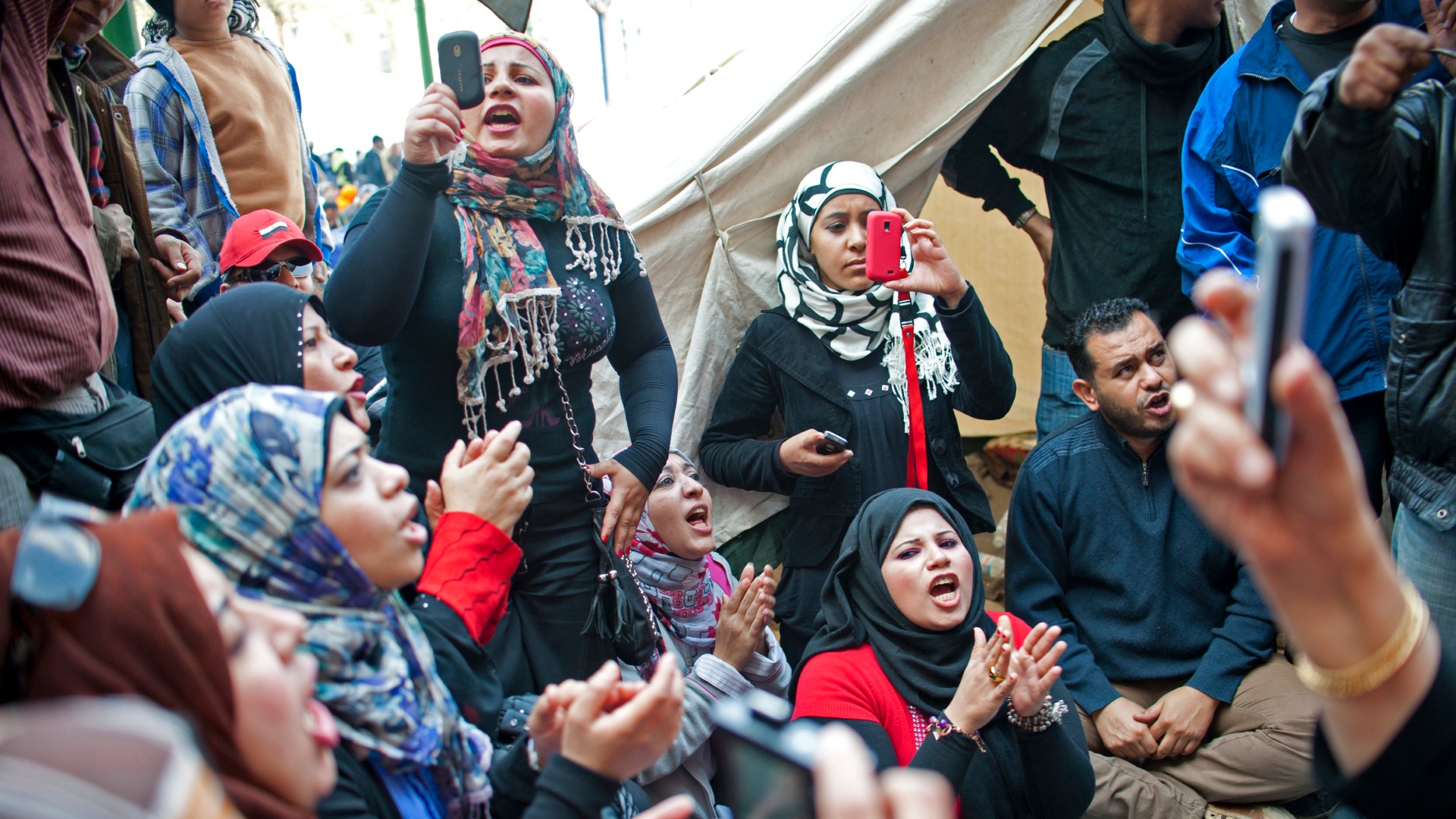
Protesters set up tents, organized food distribution, and created makeshift medical clinics.
People from many different backgrounds joined the demonstrations:
• Students
• Workers
• Professionals
• Journalists
• Religious leaders
• Families with children
The protests united Egyptians across religious and political lines.
Muslims and Christians stood side by side calling for political change.
The central demand of the movement became simple and direct:
“The people demand the fall of the regime.”
Social Media and Digital Activism


4
Digital communication networks played a significant role in organizing the protests.
Egyptian activists used platforms such as:
• Facebook
• Twitter
• YouTube
• Online blogs and forums
One influential Facebook page called “We Are All Khaled Said” helped mobilize activists.
The page was named after a young Egyptian man who died after being beaten by police, becoming a symbol of opposition to police brutality.
Social media allowed activists to:
• Coordinate demonstrations
• Share videos of protests
• Communicate with international media
• Spread information quickly across the country
The Egyptian government attempted to slow the protests by shutting down internet access across the country for several days.
However, the demonstrations continued to grow.
The attempt to control information only increased global attention on the uprising.
The Clashes and the Government Response


4
As the protests intensified, clashes between demonstrators and security forces became more frequent.
Police used tear gas, water cannons, and rubber bullets to disperse crowds.
In several incidents, violence erupted between government supporters and protesters.
One of the most dramatic confrontations occurred during the “Battle of the Camel”, when pro-government supporters on horses and camels attacked demonstrators in Tahrir Square.
Despite these clashes, protesters remained in the square.
Their determination became a powerful symbol of resistance.
The Egyptian military eventually deployed forces in Cairo.
However, unlike the police, the military largely avoided direct confrontation with protesters.
Mubarak’s Resignation


4
After more than two weeks of demonstrations, the political situation reached a critical point.
On February 11, 2011, Vice President Omar Suleiman announced that Hosni Mubarak had resigned.
Power was transferred to the Supreme Council of the Armed Forces, which promised to oversee a political transition.
The announcement triggered scenes of celebration across Egypt.
Millions of people filled the streets cheering and waving Egyptian flags.
The fall of Mubarak became one of the defining moments of the Arab Spring.
Egypt’s Political Transition
After Mubarak’s resignation, Egypt entered a complex political transition.
Several major developments followed:
• Parliamentary elections were held in 2011
• Presidential elections were held in 2012
• A new constitution was drafted
In 2012, Mohamed Morsi, a member of the Muslim Brotherhood, became Egypt’s first democratically elected president.
However, political tensions continued to grow between different factions of Egyptian society.
In 2013, massive protests erupted against Morsi’s government.
The Egyptian military intervened and removed him from power.
The military leader Abdel Fattah el-Sisi later became president.
Why the Egyptian Revolution Matters
The Egyptian Revolution was one of the most influential events of the Arab Spring.
It demonstrated how mass civic mobilization could challenge long-standing political systems.
The protests also highlighted the power of:
• Youth activism
• Digital communication networks
• Public solidarity across social groups
At the same time, Egypt’s experience showed that removing a leader does not necessarily produce immediate political stability.
The country’s political transition involved multiple phases of conflict, reform, and institutional restructuring.
Egypt Today
Today Egypt remains one of the most influential countries in the Middle East.
The events of 2011 continue to shape political debates within Egyptian society.
For many citizens, the revolution remains a powerful symbol of the people’s ability to challenge entrenched political authority.
For others, it serves as a reminder of the complexities and uncertainties that accompany major political transformations.
The Tahrir Square Revolution remains one of the most important chapters in modern Middle Eastern history and one of the defining moments of the Arab Spring.
Similar Tags
Search
Subscribe
Donate


Your Statistics
For the care and safety of this prayer space, we gently record the time and location of each visit. This helps us protect sincerity while preserving anonymity.
Your Date and Time
IP Addres:
216.73.216.124
System
- OS Linux n
- PHP 8.3.30
- MySQLi 10.6.25-MariaDB-log
- Time 04:08
- Caching Disabled
- Gzip Disabled
- Users 131
- Articles 315
- Articles View Hits 17606
Website Visitors Map
About Greg Loucks
Greg Loucks is a writer, poet, filmmaker, musician, and graphic designer, as well as a creative visionary and faith-driven storyteller working at the intersection of language, meaning, and human connection. Born and raised in Phoenix, Arizona, he has lived in Cincinnati, Ohio; Hot Springs, Arkansas; Williams, Arizona; and Flagstaff, Arizona—each place shaping his perspective, resilience, and creative voice.

Address:
United States of America and Europe
Phone Numbers:
Arizona: (928) 563-GREG (4734)
Tennessee: (615) 899-GREG (4734)
Toll-Free: 888-457-GREG (4734)

Comments