



🖊️ Post


🌍🎨Color Revolution Series Part 8 🇲🇩 Moldova: The Twitter Revolution and the Struggle Between East and West


4
The 2009 protest movement in Moldova, often referred to as the “Twitter Revolution,” became one of the earliest political uprisings in Eastern Europe to be strongly associated with social media activism.
Although it did not officially carry a color-based name like the Rose Revolution in Georgia or the Orange Revolution in Ukraine, many analysts consider Moldova’s protests part of the broader wave of Color Revolution-style movements that spread across post-Soviet states during the early 2000s.
The demonstrations erupted after a disputed parliamentary election and quickly escalated into massive protests in the capital city of Chișinău.
For supporters, the protests represented a youth-led demand for democratic reform and closer ties with Europe.
For critics, the events raised questions about foreign influence, information warfare, and geopolitical competition between Russia and Western institutions.
The Moldovan protests also became notable for their connection to digital communication platforms, marking one of the earliest examples of how social media could help organize large-scale political demonstrations.
Moldova After the Soviet Union
To understand the 2009 protests, it is necessary to examine Moldova’s political history following the collapse of the Soviet Union.
Moldova became an independent country in 1991 after the dissolution of the USSR.
The country quickly faced several major challenges:
• Economic instability
• Political fragmentation
• Regional tensions
• Identity debates between Romanian and Moldovan national identity
One of the most significant conflicts occurred in the early 1990s when the eastern region of Transnistria declared independence.
The resulting conflict led to a brief war between Moldovan forces and separatist fighters supported by Russian troops.
Although the conflict ended with a ceasefire, Transnistria has remained a de facto separate territory ever since, supported politically and militarily by Russia.
This unresolved conflict has continued to shape Moldova’s politics and foreign policy.
Throughout the 2000s, Moldova remained one of the poorest countries in Europe, with many citizens leaving the country to work abroad.
Economic hardship and political dissatisfaction created fertile ground for protest movements.
The Communist Government
During the early 2000s, Moldova was governed by the Party of Communists of the Republic of Moldova, led by President Vladimir Voronin.
Despite the party’s name, the government operated within a multi-party political system and maintained diplomatic relations with both Russia and European institutions.
However, critics accused the government of:
• Restricting media freedom
• Manipulating elections
• Maintaining close ties with Russia
• Limiting political opposition
At the same time, a growing segment of Moldova’s younger population increasingly favored closer integration with the European Union.
These divisions created a political environment in which Moldova was often described as caught between East and West.
The 2009 Parliamentary Election
The immediate trigger for the protests occurred during the parliamentary elections held on April 5, 2009.
When the official results were announced, the Communist Party claimed victory with approximately 50 percent of the vote, giving it a majority in parliament.
Opposition parties and many citizens immediately questioned the legitimacy of the results.
They accused the government of voter fraud and manipulation of the electoral process.
Young activists and opposition groups began organizing protests in Chișinău.
Initially, the demonstrations were relatively small.
However, within a few days they expanded rapidly as thousands of citizens gathered in the city center.
The Rise of the Protest Movement


4
By April 7, the protests had grown dramatically.
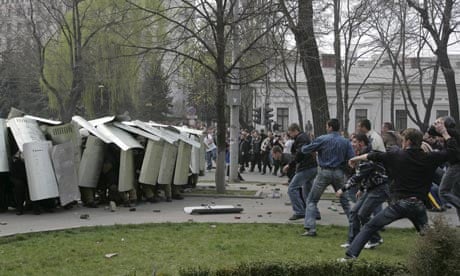
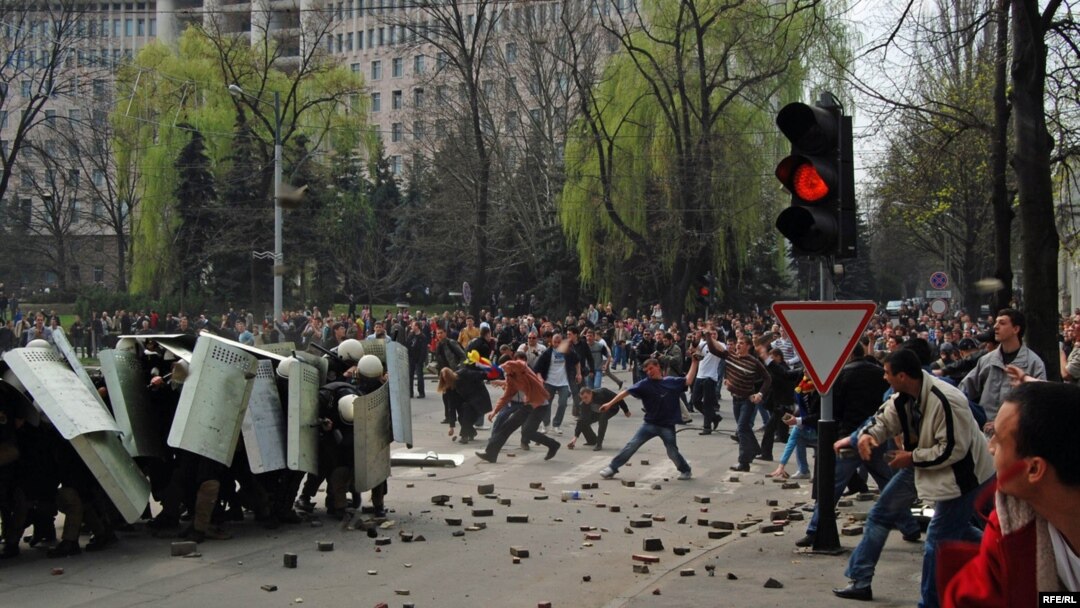
Thousands of demonstrators filled the streets of Chișinău, gathering in front of government buildings including the parliament and presidential offices.
The demonstrations were driven largely by students and young activists, many of whom were frustrated with economic conditions and the lack of political opportunities.
Protesters carried flags and banners calling for:
• New elections
• Democratic reforms
• Greater political freedoms
Many demonstrators also waved European Union flags, symbolizing their desire for closer ties with Europe.
The protests initially remained peaceful.
However, tensions soon escalated.
Large crowds stormed government buildings, and parts of the parliament building were set on fire.
The dramatic scenes shocked the country and quickly attracted international attention.
Social Media and the “Twitter Revolution”

4
One of the most widely discussed aspects of the Moldovan protests was the role of social media and digital communication.
Young activists used platforms such as:
• Twitter
• Facebook
• Online forums
• Text messaging
These tools allowed demonstrators to rapidly organize protests and share information.
Because Twitter was particularly visible during the demonstrations, international media began referring to the events as the “Twitter Revolution.”
Although social media did not single-handedly cause the protests, it played an important role in accelerating the spread of information and mobilizing participants.
Images and videos of demonstrations spread quickly across the internet.
These visuals helped draw global attention to the unfolding political crisis.
The Moldovan protests therefore became one of the earliest examples of how digital communication technologies could influence political mobilization.
The Government Response

4
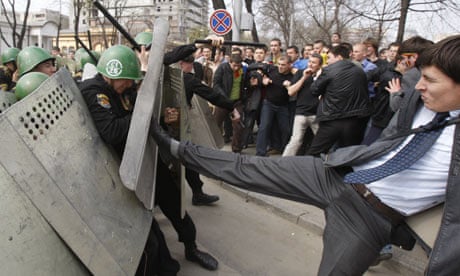
The Moldovan government responded to the unrest with a strong security crackdown.
Police forces moved to disperse demonstrators and regain control of government buildings.
Authorities arrested hundreds of protesters.
Opposition groups accused the government of using excessive force and mistreating detainees.
The political crisis deepened as both sides accused each other of escalating the situation.
Government officials claimed that the protests were influenced by foreign actors attempting to destabilize the country.
Opposition leaders argued that the demonstrations represented a legitimate popular uprising against electoral fraud.
NGOs, Civil Society, and International Debate
As with other Color Revolution-style movements, the events in Moldova sparked debate about the role of civil society organizations and international actors.
Various organizations promoting democratic governance had supported programs in Moldova related to:
• Election monitoring
• Media development
• Civic education
• Political transparency
Institutions involved in these initiatives across Eastern Europe included organizations such as:
• The Open Society Foundations, associated with George Soros
• The National Endowment for Democracy (NED)
• The National Democratic Institute (NDI)
• The International Republican Institute (IRI)
Supporters argue that such programs help strengthen democratic institutions.
Critics argue that external involvement can influence domestic political dynamics.
Regardless of these debates, the protests were largely driven by domestic political dissatisfaction and economic frustrations.
The Political Aftermath
The crisis eventually forced Moldova into a series of new elections.
The political landscape began to shift as opposition parties formed coalitions that challenged the long-standing Communist government.
By late 2009, a coalition of pro-European political parties known as the Alliance for European Integration had taken control of the government.
The new leadership pursued policies aimed at strengthening Moldova’s relationship with European institutions.
However, Moldova’s political environment remained unstable.
The country continued to experience:
• Political deadlock
• Government turnover
• Ongoing debates about relations with Russia and the European Union
Moldova Between East and West
Moldova occupies a sensitive geopolitical position between Russia and the European Union.
This position has made the country a frequent arena for political competition between different international influences.
Several key factors shape Moldova’s foreign policy debates:
• The unresolved status of Transnistria
• Economic ties with both Russia and Europe
• Cultural and historical connections with Romania
These issues continue to influence Moldova’s political direction.
Why the Moldova Protests Matter
The 2009 protests in Moldova became an important case study in the evolution of modern political movements.
They demonstrated several key features that would later appear in other uprisings:
• Youth-driven protest movements
• The rapid mobilization power of social media
• Political crises triggered by disputed elections
• The interaction between domestic protests and international geopolitical narratives
The protests also highlighted how information technologies were beginning to transform political activism.
Even though social media was still relatively new at the time, it played a visible role in spreading information and coordinating demonstrations.
Moldova Today
Today, Moldova continues to navigate a complex political landscape.
The country remains divided between competing visions for its future:
• Closer integration with the European Union
• Maintaining strong ties with Russia
Political reforms, economic challenges, and the unresolved status of Transnistria continue to shape the country’s future.
The events of April 2009 remain one of the most significant moments in Moldova’s modern political history.
They revealed how a combination of youth activism, digital communication, and political dissatisfaction could rapidly transform the political environment of a small but strategically important country.
Similar Tags
Search
Subscribe
Donate


Your Statistics
For the care and safety of this prayer space, we gently record the time and location of each visit. This helps us protect sincerity while preserving anonymity.
Your Date and Time
IP Addres:
216.73.216.29
System
- OS Linux n
- PHP 8.3.30
- MySQLi 10.6.25-MariaDB-log
- Time 20:24
- Caching Disabled
- Gzip Disabled
- Users 10
- Articles 315
- Articles View Hits 6413
Website Visitors Map
About Greg Loucks
Greg Loucks is a writer, poet, filmmaker, musician, and graphic designer, as well as a creative visionary and faith-driven storyteller working at the intersection of language, meaning, and human connection. Born and raised in Phoenix, Arizona, he has lived in Cincinnati, Ohio; Hot Springs, Arkansas; Williams, Arizona; and Flagstaff, Arizona—each place shaping his perspective, resilience, and creative voice.

Address:
United States of America and Europe
Phone Numbers:
Arizona: (928) 563-GREG (4734)
Tennessee: (615) 899-GREG (4734)
Toll-Free: 888-457-GREG (4734)

Terms & Conditions
Subscribe
Report
My comments