


- 🏠 Home
- ❓ About
- 🧑 Greg Loucks
- 📝 Testimony
- 📚 Categories
- 🗓️ Calendar
- 🪶 Poetry
- 📝 Blogs
- 🎙️ Podcast
- 📱 Social
- 📌 Forum
- 🔊 Messages
- 📷 Photos
- 🎥 Video
- 💼 Business
- ✝ Ministry
- 🌐 Network
- 🌍 Geography
- 📜 History
- 🔭 Science
- 🧬 Life
- 🤖 Technology
- 🐶 Dogs
- 🚗 Cars
- 🎮 Games
- 🪄 Magic
- 🤹 Juggling
- 🪀 Yo-Yo
- 🎈 Balloons
- 🛞 Unicycling
- 🎨 Art
- 📻 Radio
- 📺 Television
- 🎬 Movies
- 🎵 Music
- 🍔 Food
- 💳 Donate
- 🛒 Store
- 🤝 Help
- 📧 Contact
🖊️ Post


☪︎ The Arab Spring Part 2: 🇹🇳 Tunisia: The Revolution That Sparked the Arab Spring
write new blog series about Color Revolutions start with an introuction to this series and what a Color Revolution is and then right about Ukraine the Orange Revolution, George Soros and NGOs and the Euromaiden and Revolution of Dignity then the current war with Ukraine
🌍🎨 Series Introduction: Understanding “Color Revolutions”


4
In the modern political landscape, one term appears repeatedly in discussions about regime change, geopolitical influence, and popular uprisings: the “Color Revolution.”
From Georgia’s Rose Revolution to Ukraine’s Orange Revolution, from Kyrgyzstan’s Tulip Revolution to various movements across Eastern Europe and Central Asia, these events are often presented as spontaneous democratic uprisings against corruption and authoritarianism.
Yet critics and analysts alike argue that these movements often involve external influence, international funding networks, activist training programs, and strategic geopolitical interests.
This new blog series will explore Color Revolutions around the world — their origins, the organizations involved, the political consequences, and how they reshape global power dynamics.
Each article will examine:
• The historical background of the country
• The political conditions before the revolution
• The role of NGOs, foreign funding, and media influence
• The events of the uprising itself
• The aftermath and geopolitical consequences
Some revolutions led to democratic reforms. Others produced instability, economic hardship, or long-term geopolitical conflict.
Understanding them requires looking beyond slogans and examining the deeper political machinery behind modern protest movements.
This series begins with one of the most influential examples: Ukraine.
🇺🇦 Ukraine: The Orange Revolution, Euromaidan, and the Road to War


4
Ukraine has been the site of two major Color Revolutions within a decade, each reshaping the country’s political orientation and its relationship with Russia and the West.
These movements — the Orange Revolution (2004) and the Euromaidan protests (2013–2014) — dramatically altered Ukraine’s political trajectory and ultimately helped set the stage for the current war between Russia and Ukraine.
To understand the conflict today, we must first examine the revolutions that preceded it.
The Orange Revolution (2004)
In 2004, Ukraine faced a deeply contested presidential election.
The two main candidates represented two different geopolitical directions for the country:
Viktor Yanukovych
-
Supported closer ties with Russia
-
Backed by then-President Leonid Kuchma
-
Favored stronger economic ties with Moscow
Viktor Yushchenko
-
Advocated closer integration with Europe and NATO
-
Supported by many Ukrainian nationalists and Western governments
When the election results declared Yanukovych the winner, allegations of widespread election fraud immediately surfaced.
Mass protests erupted across the country, centered in Kyiv’s Independence Square.
Demonstrators wore orange, the campaign color of Yushchenko, giving the movement its name:
The Orange Revolution.
Hundreds of thousands of people filled the streets for weeks demanding new elections.
Ukraine’s Supreme Court eventually invalidated the results and ordered a new vote.
In the rerun election, Viktor Yushchenko won the presidency.
For many Western observers, the Orange Revolution represented a triumph of democracy.
For critics, it represented the beginning of heavy Western political influence in Ukrainian politics.
NGOs, Activist Training, and Western Influence


4
One of the most debated aspects of Color Revolutions is the role of international NGOs and activist networks.
Organizations linked to Western democracy-promotion initiatives helped train activists in nonviolent protest strategies, media messaging, and political organization.
These groups often drew inspiration from the Serbian movement Otpor, which helped overthrow Slobodan Milošević in 2000.
Training programs for activists were funded or supported by organizations such as:
• The Open Society Foundations, associated with George Soros
• The National Endowment for Democracy (NED)
• The International Republican Institute (IRI)
• The National Democratic Institute (NDI)
Supporters argue these programs strengthened civil society and democratic participation.
Critics argue they effectively functioned as tools of Western geopolitical influence, helping steer post-Soviet countries away from Russian influence and toward NATO and EU alignment.
Regardless of perspective, there is little doubt that NGOs and activist networks played a role in shaping the strategies used during these protests.
The Euromaidan Protests (2013–2014)


4
Nearly a decade after the Orange Revolution, Ukraine faced another political crisis.
In 2010, Viktor Yanukovych returned to power, winning the presidency in a new election.
This time, however, the crisis emerged over Ukraine’s relationship with the European Union.
In 2013, Ukraine was expected to sign an Association Agreement with the EU, which would move the country economically and politically closer to Europe.
But at the last moment, Yanukovych suspended the agreement, choosing instead to pursue closer economic ties with Russia.
The decision sparked protests in Kyiv.
Initially small, the demonstrations grew rapidly after police violently dispersed student protesters.
Soon, hundreds of thousands of Ukrainians filled Independence Square again, creating a massive protest encampment known as Euromaidan.
The protests lasted for months and eventually escalated into violent clashes between protesters and security forces.
In February 2014, after deadly confrontations that killed dozens, Yanukovych fled the country.
Ukraine’s parliament removed him from power and formed a new government.
Supporters called the event the “Revolution of Dignity.”
Critics called it a Western-backed coup.
The Geopolitical Consequences


4
The events of 2014 triggered the most serious geopolitical crisis in Europe since the Cold War.
Within weeks of Yanukovych’s removal:
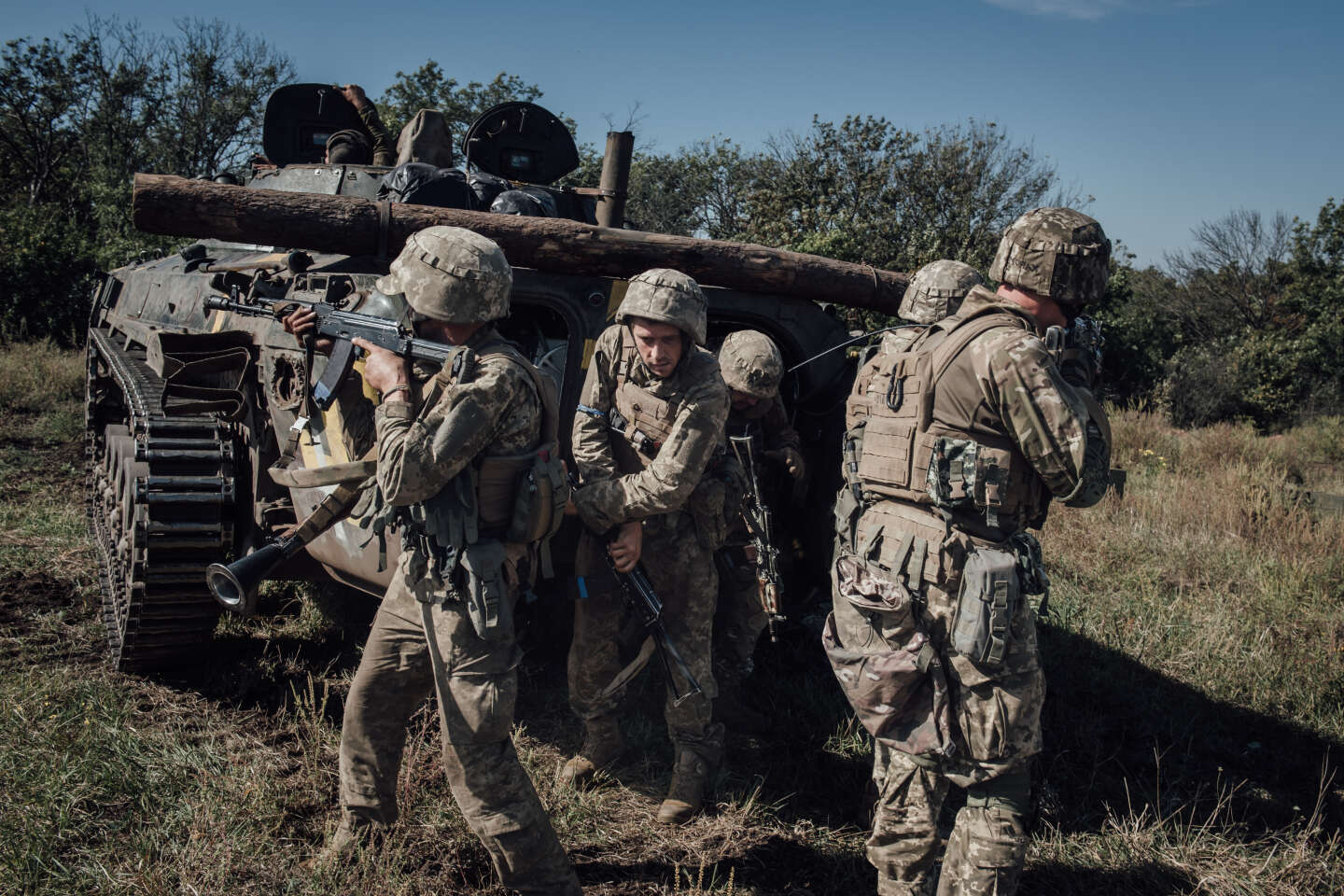
Russia annexed Crimea, citing the protection of Russian speakers and strategic interests.
In eastern Ukraine, separatist movements emerged in Donetsk and Luhansk, leading to a prolonged war in the Donbas region.
The conflict simmered for eight years until Russia launched a full-scale invasion of Ukraine in February 2022.
Today the war remains one of the most significant geopolitical conflicts of the 21st century.
Why Ukraine Matters
Ukraine sits at the crossroads of two competing geopolitical visions:
• Integration with European institutions such as the EU and NATO
• Continued alignment with Russia’s sphere of influence
The Color Revolutions in Ukraine did more than change governments.
They reshaped the balance of power in Eastern Europe.
For supporters, they represent the triumph of democratic aspirations.
For critics, they represent externally influenced political upheavals that destabilized the region.
Either way, they became turning points that helped lead to the current war.
Next in the Series
Future articles in this series will examine other Color Revolutions around the world, including:
• Georgia – The Rose Revolution
• Kyrgyzstan – The Tulip Revolution
• Lebanon – The Cedar Revolution
• Belarus – The attempted 2020 uprising
• The Arab Spring and its connections to color revolution strategies
Each case reveals different dynamics between grassroots protest movements, international influence, and global power politics.
Understanding these revolutions is essential to understanding how modern political change — and sometimes modern conflict — unfolds in the 21st century.
make twice as long and bring up the new media and propaganda during Euromaien and keep 100% already there
🌍🎨 Series Introduction: Understanding Color Revolutions
4
In the modern political landscape, one term appears repeatedly in discussions about regime change, geopolitical influence, and popular uprisings: the “Color Revolution.”
From Georgia’s Rose Revolution to Ukraine’s Orange Revolution, from Kyrgyzstan’s Tulip Revolution to various movements across Eastern Europe and Central Asia, these events are often presented as spontaneous democratic uprisings against corruption and authoritarianism.
Yet critics and analysts alike argue that these movements often involve external influence, international funding networks, activist training programs, and strategic geopolitical interests.
This new blog series will explore Color Revolutions around the world — their origins, the organizations involved, the political consequences, and how they reshape global power dynamics.
Each article will examine:
• The historical background of the country
• The political conditions before the revolution
• The role of NGOs, foreign funding, and media influence
• The events of the uprising itself
• The aftermath and geopolitical consequences
Some revolutions led to democratic reforms. Others produced instability, economic hardship, or long-term geopolitical conflict.
Understanding them requires looking beyond slogans and examining the deeper political machinery behind modern protest movements.
In the 20th century, revolutions were often fought with weapons and armies. In the 21st century, revolutions are increasingly fought with media narratives, international pressure, economic leverage, social networks, and public perception.
Information itself has become a strategic weapon.
Television networks, activist livestreams, viral videos, hashtags, and international news coverage can influence global opinion in real time. Governments, NGOs, political movements, and intelligence agencies all recognize that controlling the narrative can be nearly as important as controlling territory.
Because of this, Color Revolutions are not only political events — they are also information wars.
They involve messaging strategies, symbolic imagery, slogans, protest branding, and international media campaigns designed to shape global understanding of events.
This series will explore both sides of these revolutions:
• The genuine grassroots frustrations of citizens
• The international networks that sometimes amplify those movements
The goal is not to reduce these events to simple explanations, but to understand the complex intersection of local protest movements, foreign influence, and global geopolitics.
This series begins with one of the most influential examples: Ukraine.
🇺🇦 Ukraine: The Orange Revolution, Euromaidan, and the Road to War
4
Ukraine has been the site of two major Color Revolutions within a decade, each reshaping the country’s political orientation and its relationship with Russia and the West.
These movements — the Orange Revolution (2004) and the Euromaidan protests (2013–2014) — dramatically altered Ukraine’s political trajectory and ultimately helped set the stage for the current war between Russia and Ukraine.
To understand the conflict today, we must first examine the revolutions that preceded it.
Ukraine’s unique geopolitical position has long made it a strategic crossroads between East and West.
Historically, the country has been deeply connected to Russia through centuries of shared imperial history under the Russian Empire and later the Soviet Union. At the same time, western regions of Ukraine have strong cultural and historical ties with Central and Eastern Europe.
Since gaining independence after the collapse of the Soviet Union in 1991, Ukraine has often been politically divided between:
• Pro-European political movements seeking integration with Western institutions
• Political factions favoring closer economic and cultural ties with Russia
These competing visions created a fragile political balance that would repeatedly erupt into crisis.
The Orange Revolution (2004)
In 2004, Ukraine faced a deeply contested presidential election.
The two main candidates represented two different geopolitical directions for the country:
Viktor Yanukovych
-
Supported closer ties with Russia
-
Backed by then-President Leonid Kuchma
-
Favored stronger economic ties with Moscow
Viktor Yushchenko
-
Advocated closer integration with Europe and NATO
-
Supported by many Ukrainian nationalists and Western governments
When the election results declared Yanukovych the winner, allegations of widespread election fraud immediately surfaced.
Mass protests erupted across the country, centered in Kyiv’s Independence Square.
Demonstrators wore orange, the campaign color of Yushchenko, giving the movement its name:
The Orange Revolution.
Hundreds of thousands of people filled the streets for weeks demanding new elections.
Ukraine’s Supreme Court eventually invalidated the results and ordered a new vote.
In the rerun election, Viktor Yushchenko won the presidency.
For many Western observers, the Orange Revolution represented a triumph of democracy.
For critics, it represented the beginning of heavy Western political influence in Ukrainian politics.
The Orange Revolution also demonstrated the growing importance of modern media in shaping political events.
Independent television channels, international news organizations, and early internet forums played a significant role in spreading information about alleged election fraud and organizing protest activity.
Satellite television and foreign media coverage helped bring the protests to global audiences, increasing international pressure on Ukraine’s leadership.
These developments foreshadowed the far more powerful social media and digital media environment that would shape the next revolution nearly a decade later.
NGOs, Activist Training, and Western Influence
4
One of the most debated aspects of Color Revolutions is the role of international NGOs and activist networks.
Organizations linked to Western democracy-promotion initiatives helped train activists in nonviolent protest strategies, media messaging, and political organization.
These groups often drew inspiration from the Serbian movement Otpor, which helped overthrow Slobodan Milošević in 2000.
Otpor activists developed a strategy often called “nonviolent resistance” or “strategic civil resistance.”
This included tactics such as:
• Mass demonstrations
• Symbolic protest imagery
• Political satire and messaging
• Decentralized organization
• Media-focused protest events designed to generate international attention
Training programs for activists were funded or supported by organizations such as:
• The Open Society Foundations, associated with George Soros
• The National Endowment for Democracy (NED)
• The International Republican Institute (IRI)
• The National Democratic Institute (NDI)
Supporters argue these programs strengthened civil society and democratic participation.
Critics argue they effectively functioned as tools of Western geopolitical influence, helping steer post-Soviet countries away from Russian influence and toward NATO and EU alignment.
Regardless of perspective, there is little doubt that NGOs and activist networks played a role in shaping the strategies used during these protests.
The Euromaidan Protests (2013–2014)
4
Nearly a decade after the Orange Revolution, Ukraine faced another political crisis.
In 2010, Viktor Yanukovych returned to power, winning the presidency in a new election.
This time, however, the crisis emerged over Ukraine’s relationship with the European Union.
In 2013, Ukraine was expected to sign an Association Agreement with the EU, which would move the country economically and politically closer to Europe.
But at the last moment, Yanukovych suspended the agreement, choosing instead to pursue closer economic ties with Russia.
The decision sparked protests in Kyiv.
Initially small, the demonstrations grew rapidly after police violently dispersed student protesters.
Soon, hundreds of thousands of Ukrainians filled Independence Square again, creating a massive protest encampment known as Euromaidan.
The protests lasted for months and eventually escalated into violent clashes between protesters and security forces.
In February 2014, after deadly confrontations that killed dozens, Yanukovych fled the country.
Ukraine’s parliament removed him from power and formed a new government.
Supporters called the event the “Revolution of Dignity.”
Critics called it a Western-backed coup.
The Role of New Media and Information Warfare During Euromaidan
The Euromaidan protests took place in a completely different media environment than the Orange Revolution.
By 2013, the rise of social media platforms, smartphones, livestreaming, and viral video had transformed how political movements operated.
Platforms such as Facebook, Twitter, YouTube, and emerging livestream networks became critical tools for organizing demonstrations and spreading information.
Protesters used social media to:
• Coordinate protest locations and logistics
• Share real-time footage from demonstrations
• Document clashes with police
• Spread slogans, memes, and protest imagery
• Mobilize international attention
Livestreams from Kyiv’s Independence Square allowed people around the world to watch events unfold in real time.
Images of burning barricades, injured protesters, and massive crowds quickly circulated across international media networks.
At the same time, the information environment became deeply polarized.
Western media outlets often portrayed Euromaidan as a popular democratic uprising against corruption and authoritarian leadership.
Russian state media and pro-Russian outlets framed the protests very differently, often describing them as a Western-backed attempt to destabilize Ukraine and pull it away from Russia’s sphere of influence.
Both sides engaged in intense information campaigns aimed at shaping international perception.
This period marked one of the earliest large-scale examples of modern hybrid information warfare, where narrative control, media framing, and viral content became central to geopolitical conflict.
The battle for public opinion was fought across television broadcasts, news websites, social media platforms, and online forums.
In many ways, the Euromaidan protests represented not only a political revolution but also a turning point in how information itself could drive political change.
The Geopolitical Consequences
4
The events of 2014 triggered the most serious geopolitical crisis in Europe since the Cold War.
Within weeks of Yanukovych’s removal:
Russia annexed Crimea, citing the protection of Russian speakers and strategic interests.
In eastern Ukraine, separatist movements emerged in Donetsk and Luhansk, leading to a prolonged war in the Donbas region.
The conflict simmered for eight years until Russia launched a full-scale invasion of Ukraine in February 2022.
Today the war remains one of the most significant geopolitical conflicts of the 21st century.
The war has reshaped global politics in numerous ways:
• NATO expansion debates intensified
• Energy markets were disrupted across Europe
• Sanctions regimes against Russia expanded dramatically
• Global military spending increased
• The conflict deepened divisions between Western countries and Russia
Ukraine has become a central battlefield in the struggle between competing geopolitical blocs.
Why Ukraine Matters
Ukraine sits at the crossroads of two competing geopolitical visions:
• Integration with European institutions such as the EU and NATO
• Continued alignment with Russia’s sphere of influence
The Color Revolutions in Ukraine did more than change governments.
They reshaped the balance of power in Eastern Europe.
For supporters, they represent the triumph of democratic aspirations.
For critics, they represent externally influenced political upheavals that destabilized the region.
Either way, they became turning points that helped lead to the current war.
The events in Ukraine also demonstrated that modern revolutions are no longer fought only in the streets.
They are fought simultaneously through:
• Media narratives
• International diplomacy
• Economic sanctions
• Cyber operations
• Social media campaigns
The battlefield of modern politics now extends into the digital information space, where perception, narrative, and influence can shape events as powerfully as armies.
Next in the Series
Future articles in this series will examine other Color Revolutions around the world, including:
• Georgia – The Rose Revolution
• Kyrgyzstan – The Tulip Revolution
• Lebanon – The Cedar Revolution
• Belarus – The attempted 2020 uprising
• The Arab Spring and its connections to color revolution strategies
Each case reveals different dynamics between grassroots protest movements, international influence, and global power politics.
Understanding these revolutions is essential to understanding how modern political change — and sometimes modern conflict — unfolds in the 21st century.
Do Georgia just ad long
🇬🇪 Georgia: The Rose Revolution and the Reorientation of a Nation


4
The Rose Revolution of 2003 in Georgia became one of the earliest and most influential examples of a modern Color Revolution.
Like later uprisings in Ukraine, Kyrgyzstan, and elsewhere, the events in Georgia combined mass protest movements, civil society activism, international political pressure, and modern media narratives.
The revolution ultimately led to the resignation of long-time president Eduard Shevardnadze and brought a new generation of pro-Western leaders into power.
For supporters, the Rose Revolution represented a peaceful democratic transformation.
For critics, it illustrated how international networks, NGOs, and geopolitical interests could shape political change in post-Soviet states.
Understanding the Rose Revolution helps explain how Georgia moved from a struggling post-Soviet republic into one of the most pro-Western governments in the former Soviet space.
Georgia After the Soviet Union
When the Soviet Union collapsed in 1991, Georgia entered independence facing severe challenges.
The country struggled with:
• Economic collapse
• Widespread corruption
• Weak government institutions
• Ethnic conflicts and separatist regions
• Power struggles between political factions
Georgia’s first president, Zviad Gamsakhurdia, was overthrown in a violent coup in 1992.
Following the turmoil, Eduard Shevardnadze emerged as the country’s leader.
Shevardnadze had previously served as Foreign Minister of the Soviet Union under Mikhail Gorbachev and played a major role in the diplomacy that helped end the Cold War.
Initially, many Georgians hoped he could stabilize the country.
However, throughout the 1990s and early 2000s, Georgia remained plagued by:
• Deep corruption
• Weak economic growth
• Organized crime
• Poor infrastructure
• Unreliable electricity and public services
Public frustration steadily grew.
By the early 2000s, many Georgians believed the government had become ineffective, corrupt, and disconnected from the population.
These conditions created fertile ground for a political uprising.
The Disputed 2003 Parliamentary Election
The immediate trigger for the Rose Revolution was Georgia’s 2003 parliamentary election.
Opposition parties accused the government of large-scale election fraud.
International election observers also reported irregularities.
Exit polls suggested that opposition parties had performed far better than the official results indicated.
Protests began to grow in Tbilisi, Georgia’s capital.
Opposition leaders accused the government of manipulating the election to maintain power.
At the center of the opposition movement was Mikheil Saakashvili, a young reform-minded politician who had previously served as Georgia’s Minister of Justice.
Saakashvili and other opposition leaders called on citizens to take to the streets.
Soon, tens of thousands of protesters gathered outside the Georgian parliament.
The Symbolism of the Rose

4
The defining image of the revolution occurred when protesters entered parliament carrying roses instead of weapons.
Opposition leader Mikheil Saakashvili famously walked into the parliament chamber holding a rose during a speech by President Shevardnadze.
The symbolism was powerful.
The rose represented peaceful resistance.
Rather than a violent uprising, the movement presented itself as a nonviolent revolution against corruption and election fraud.
The image of protesters holding flowers spread rapidly through international media.
The moment became one of the most recognizable symbols of modern Color Revolutions.
Within days, the protests forced Shevardnadze to resign.
Georgia’s Supreme Court annulled the election results, and new elections were scheduled.
Saakashvili soon won the presidency with overwhelming support.
NGOs, Activist Training, and International Influence


4
As with other Color Revolutions, analysts have debated the role of international NGOs and activist training programs.
One of the key protest organizations in Georgia was a youth movement called Kmara (“Enough”).
Kmara activists organized demonstrations, distributed protest materials, and helped mobilize students across the country.
The movement drew inspiration from the Serbian protest group Otpor, which had helped overthrow Slobodan Milošević in 2000.
Otpor activists had developed strategies based on nonviolent resistance, symbolic protest imagery, and media-focused activism.
Members of Kmara reportedly received training and support through various international programs connected to democracy promotion organizations.
Funding and support for civil society initiatives in Georgia came from institutions such as:
• The Open Society Foundations, associated with George Soros
• The National Endowment for Democracy (NED)
• The National Democratic Institute (NDI)
• The International Republican Institute (IRI)
Supporters of these initiatives argue that they helped build independent civil society organizations capable of holding governments accountable.
Critics argue they represented external political influence designed to shift post-Soviet countries toward Western geopolitical alignment.
Regardless of interpretation, Georgia became an important early example of how international networks could interact with local protest movements during political crises.
Media, Messaging, and the Information Battle
One of the defining features of the Rose Revolution was the strategic use of media and messaging.
Opposition groups understood the importance of visual symbolism, simple slogans, and international media coverage.
Television played a particularly important role.
Independent Georgian television networks broadcast extensive coverage of the protests and allegations of election fraud.
One of the most influential channels was Rustavi-2, which aired investigative reports exposing corruption and government mismanagement.
These broadcasts helped mobilize public anger and increased pressure on the government.
International news outlets also closely followed events in Georgia.
Images of peaceful protesters holding roses circulated across global media, shaping international perception of the movement as a nonviolent democratic uprising.
This media environment helped amplify the protest movement and added international legitimacy to the opposition.
The Rose Revolution therefore demonstrated how modern revolutions could be fought not only through political organizing but through narrative and imagery.
The Saakashvili Era
After the revolution, Mikheil Saakashvili became president in 2004.
His government launched a series of sweeping reforms aimed at modernizing Georgia and aligning it more closely with Western institutions.
Major reforms included:
• Anti-corruption campaigns
• Economic liberalization
• Police reform
• Improvements in government transparency
• Efforts to attract foreign investment
These policies produced significant changes.
Georgia’s ranking in global corruption indexes improved dramatically.
Foreign investment increased, and economic growth accelerated.
However, Saakashvili’s leadership also became controversial.
Critics accused his government of:
• Concentrating power in the presidency
• Restricting media freedom
• Using aggressive policing tactics
• Marginalizing political opponents
Over time, political polarization deepened within Georgia.
The 2008 War with Russia


4
Georgia’s shift toward Western alliances created tensions with Russia.
Two regions inside Georgia — South Ossetia and Abkhazia — had long-standing separatist movements supported by Russia.
In 2008, escalating tensions between Georgia and Russian-backed forces in South Ossetia erupted into open war.
Russian troops quickly intervened.
Within days, Russian forces pushed deep into Georgian territory.
The conflict ended with Russia recognizing South Ossetia and Abkhazia as independent states, though most of the world still considers them part of Georgia.
The war dramatically increased tensions between Russia and the West.
It also signaled how Color Revolutions and geopolitical competition could escalate into military conflict.
Why the Rose Revolution Matters
The Rose Revolution became one of the earliest models for modern Color Revolutions.
It demonstrated several key patterns that would later appear in other movements:
• Mass protests triggered by disputed elections
• Youth activist networks organizing demonstrations
• Strategic use of symbols and imagery
• Support from civil society organizations and NGOs
• Strong international media coverage
The events in Georgia also showed how political transformations in post-Soviet countries could quickly become entangled with global geopolitical rivalries.
Georgia’s decision to move toward Western institutions placed it directly in the middle of the strategic competition between Russia and the West.
Georgia Today
More than two decades after the Rose Revolution, Georgia continues to navigate a complex political landscape.
The country remains divided between:
• Leaders advocating stronger integration with European institutions
• Political factions seeking more balanced relations with Russia
Georgia has pursued closer ties with the European Union and NATO, though full membership remains uncertain.
At the same time, tensions with Russia remain unresolved due to the status of Abkhazia and South Ossetia.
The legacy of the Rose Revolution therefore continues to shape Georgia’s politics today.
It represents both:
• A moment of democratic transformation
• A turning point that pulled Georgia into a larger geopolitical struggle.
Next in the Series
The next article in this series will examine another Color Revolution that reshaped Central Asia:
🇰🇬 Kyrgyzstan – The Tulip Revolution
Like Georgia and Ukraine, Kyrgyzstan experienced mass protests following disputed elections.
The uprising toppled a long-standing government and revealed how Color Revolution dynamics could spread across multiple regions of the former Soviet world.
Together, these events form part of a larger story about how modern political revolutions unfold in the age of global media, international NGOs, and great-power competition.
Write Kyrgyzstan
🇰🇬 Kyrgyzstan: The Tulip Revolution and the Cycles of Power in Central Asia


4
The Tulip Revolution of 2005 in Kyrgyzstan became one of the most significant Color Revolutions in Central Asia.
Following the earlier revolutions in Serbia (2000), Georgia (2003), and Ukraine (2004), the uprising in Kyrgyzstan appeared to many observers as part of a broader wave of political upheaval spreading across former Soviet states.
Like other Color Revolutions, the Tulip Revolution combined mass protests, allegations of election fraud, youth activism, international attention, and media narratives that helped shape public perception of the events.
However, Kyrgyzstan’s revolution also revealed something unique.
Unlike Georgia and Ukraine, where revolutions produced relatively stable governments for several years, Kyrgyzstan would experience repeated cycles of political instability, revolutions, and leadership changes.
The Tulip Revolution therefore serves as an important example of how Color Revolutions can produce very different outcomes depending on the political, economic, and social conditions of a country.
Kyrgyzstan After the Soviet Union
When the Soviet Union collapsed in 1991, Kyrgyzstan became an independent nation for the first time in modern history.
Compared to other Central Asian states, Kyrgyzstan initially developed a reputation as one of the most politically open countries in the region.
Its first president, Askar Akayev, was originally viewed by many Western observers as a reform-minded leader who supported:
• Democratic institutions
• Market economic reforms
• Cooperation with international organizations
During the early 1990s, Kyrgyzstan even gained the nickname “the island of democracy” in Central Asia.
However, over time, the political system began to change.
By the late 1990s and early 2000s, critics accused Akayev’s government of:
• Increasing authoritarianism
• Election manipulation
• Corruption
• Concentration of power within the president’s family
Members of Akayev’s family and close allies were widely believed to have gained control of important sectors of the economy.
Public frustration began to grow.
Economic hardship also played a major role.
Kyrgyzstan struggled with:
• High unemployment
• Widespread poverty
• Weak infrastructure
• Limited economic opportunities
These frustrations created the conditions that would eventually erupt into a nationwide protest movement.
The 2005 Parliamentary Elections
The immediate trigger for the Tulip Revolution came during parliamentary elections held in February and March 2005.
Opposition candidates and political groups accused the government of widespread election fraud and manipulation.
International election observers also reported numerous irregularities.
Many opposition figures were disqualified from running, while pro-government candidates appeared to benefit from favorable treatment.
The results sparked anger across the country.
Protests began in southern Kyrgyzstan, particularly in the cities of Osh and Jalal-Abad.
Demonstrators accused the government of attempting to consolidate power through corrupt elections.
Within days, protests spread northward toward the capital city of Bishkek.
Opposition leaders began organizing demonstrations demanding that the election results be annulled.
The Rise of the Protest Movement


4
As protests intensified, a number of opposition groups and activist organizations began coordinating demonstrations.
One youth movement that gained attention was called KelKel, meaning “Renaissance” or “Rebirth.”
KelKel activists organized rallies, distributed leaflets, and used early internet tools to help mobilize supporters.
The movement drew inspiration from earlier protest groups such as:
• Otpor in Serbia
• Kmara in Georgia
• Pora in Ukraine
These movements shared similar strategies focused on:
• Nonviolent protest tactics
• Symbolic imagery
• Public demonstrations designed for media visibility
• Grassroots mobilization
However, Kyrgyzstan’s political environment was very different from Eastern Europe.
Regional divisions between the north and south of the country played a significant role in shaping the protests.
Local power networks, tribal affiliations, and regional loyalties all influenced how the uprising unfolded.
As protests grew larger, demonstrators began seizing government buildings in several cities.
The movement was no longer limited to peaceful rallies.
It had begun to transform into a nationwide political crisis.
The Fall of President Akayev
The turning point came in March 2005, when massive crowds gathered in Bishkek.
Protesters eventually stormed the presidential palace, forcing security forces to retreat.
President Askar Akayev fled the country, eventually seeking refuge in Russia.
The sudden collapse of the government shocked many observers.
Unlike the more carefully organized transitions seen in Georgia and Ukraine, the events in Kyrgyzstan unfolded rapidly and chaotically.
Government institutions struggled to maintain control.
In the immediate aftermath, looting broke out in parts of the capital.
Political leaders rushed to form an interim government.
Opposition figure Kurmanbek Bakiyev soon emerged as the country’s new leader.
Later that year, he won the presidential election.
NGOs, Civil Society, and International Influence


4
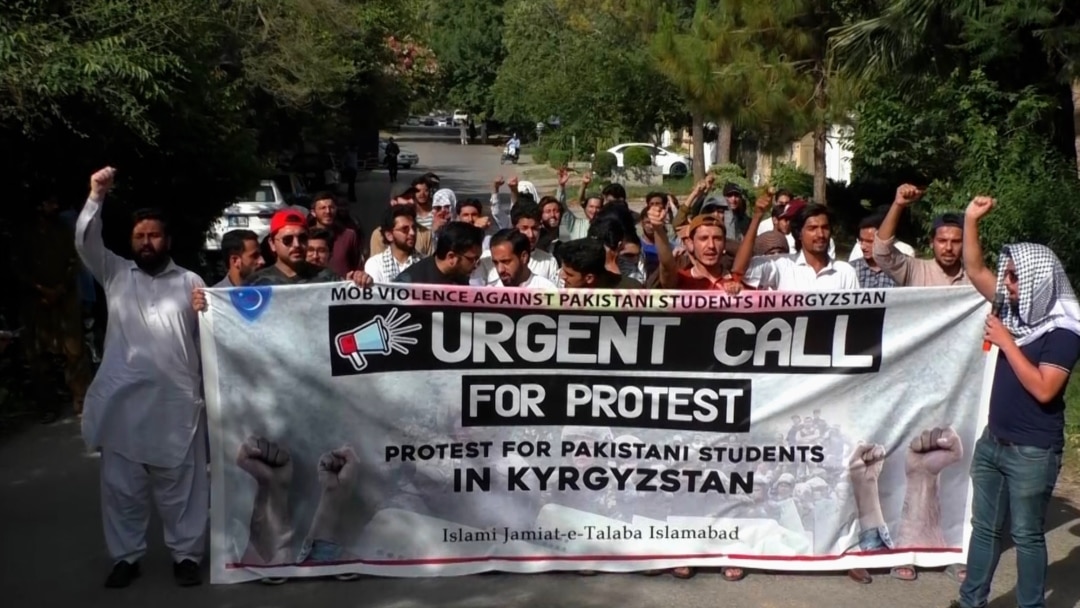
As with other Color Revolutions, the role of international NGOs and civil society organizations became a topic of debate.
Various democracy promotion groups had been active in Kyrgyzstan during the years leading up to the revolution.
Organizations involved in supporting civil society initiatives included:
• The Open Society Foundations, associated with George Soros
• The National Endowment for Democracy (NED)
• The National Democratic Institute (NDI)
• The International Republican Institute (IRI)
These organizations funded programs focused on:
• Election monitoring
• Media development
• Civic education
• Training for political activists and journalists
Supporters argue that these programs helped strengthen independent institutions and democratic participation.
Critics argue that such programs sometimes serve broader geopolitical interests, particularly in regions where global powers compete for influence.
Regardless of interpretation, Kyrgyzstan’s revolution demonstrated how civil society networks and activist organizations could interact with domestic political dissatisfaction.
Media and the Information Environment
The Tulip Revolution occurred during a period when information networks were rapidly expanding, though social media had not yet reached the dominance it would achieve later during events like Euromaidan.
Independent newspapers and regional media outlets played a significant role in spreading reports about election irregularities and government corruption.
Opposition leaders also used:
• Local radio stations
• Print media
• Early internet platforms
• International news coverage
These channels helped amplify protest messages and mobilize public anger.
International media attention further increased pressure on the Kyrgyz government.
However, Kyrgyzstan’s information environment was less developed than in Eastern Europe.
This meant that local power networks, regional alliances, and personal leadership played a larger role in shaping the outcome of events.
The Tulip Revolution therefore reflected a mix of traditional political mobilization and emerging modern protest strategies.
The Aftermath: Political Instability
The overthrow of President Akayev did not produce long-term political stability.
Instead, Kyrgyzstan entered a period of continued turmoil.
President Kurmanbek Bakiyev, who had come to power after the revolution, soon faced many of the same accusations that had been directed at the previous government.
Critics accused his administration of:
• Corruption
• Concentration of power
• Favoritism toward family members
• Suppression of political opponents
Public frustration once again began to grow.
In 2010, another uprising erupted in Kyrgyzstan.
This second revolution forced President Bakiyev to flee the country.
The political system was then restructured into a parliamentary republic, making Kyrgyzstan the only Central Asian country to adopt such a system.
However, political tensions and instability continued in the years that followed.
Why the Tulip Revolution Matters
The Tulip Revolution became a key example in the study of Color Revolutions because it showed that overthrowing a government does not automatically create stable democratic institutions.
Several important lessons emerged from Kyrgyzstan’s experience:
• Political revolutions can spread between countries through shared strategies and networks.
• Local political culture and regional divisions can strongly shape outcomes.
• Removing one leader does not necessarily resolve deeper structural problems.
Kyrgyzstan also highlighted how post-Soviet states were navigating complex pressures from both domestic populations and international geopolitical forces.
The country sits at a strategic crossroads between major powers, including:
• Russia
• China
• The United States
• Regional Central Asian neighbors
Because of this position, Kyrgyzstan has often found itself balancing competing geopolitical interests.
Kyrgyzstan Today
Today, Kyrgyzstan remains one of the most politically dynamic countries in Central Asia.
Unlike many of its neighbors, the country has experienced multiple revolutions, leadership changes, and constitutional reforms.
While political instability has been a challenge, the country also maintains a relatively active political environment compared to other states in the region.
The legacy of the Tulip Revolution therefore continues to shape Kyrgyzstan’s political culture.
It remains a powerful example of how Color Revolution movements can emerge from deep public frustration while producing unpredictable outcomes.
Next in the Series
The next article in this series will examine another Color Revolution that shook the Middle East:
🇱🇧 Lebanon – The Cedar Revolution
Triggered by the assassination of a major political leader, the Cedar Revolution sparked massive demonstrations and forced the withdrawal of Syrian troops from Lebanon.
Like other Color Revolutions, it revealed how mass protests, international pressure, and media narratives can rapidly reshape the political landscape of a country.
Do Lebanon
🇱🇧 Lebanon: The Cedar Revolution and the Struggle for Sovereignty


4
The Cedar Revolution of 2005 in Lebanon was one of the most dramatic political upheavals in the Middle East during the early 21st century.
Like the Rose Revolution in Georgia, the Orange Revolution in Ukraine, and the Tulip Revolution in Kyrgyzstan, the Cedar Revolution became associated with the broader wave of Color Revolutions that reshaped governments across several regions of the world.
Unlike many other Color Revolutions, however, the uprising in Lebanon was not primarily triggered by election disputes.
Instead, it was sparked by a political assassination that shocked the nation and triggered massive protests demanding an end to foreign influence in Lebanese politics.
The Cedar Revolution ultimately forced the withdrawal of Syrian military forces from Lebanon, ending nearly three decades of direct Syrian presence in the country.
For supporters, the movement represented a national awakening and a peaceful demand for sovereignty and democratic governance.
For critics, it illustrated how international pressure, regional rivalries, and media narratives could accelerate political change during moments of national crisis.
Understanding the Cedar Revolution requires examining Lebanon’s complex history, where politics, religion, regional geopolitics, and international influence are deeply intertwined.
Lebanon’s Complex Political System
Lebanon’s political system is unique in the Middle East.
The country operates under a confessional political system, meaning political power is distributed among religious communities.
Major leadership positions are traditionally divided as follows:
• The President must be a Maronite Christian
• The Prime Minister must be a Sunni Muslim
• The Speaker of Parliament must be a Shiite Muslim
This system was originally established to maintain balance among Lebanon’s diverse religious communities.
However, it has also contributed to political fragmentation and factional competition.
Lebanon experienced a devastating civil war from 1975 to 1990, during which multiple domestic factions, foreign governments, and militias became involved.
During the war, Syrian troops entered Lebanon in 1976, initially under the justification of stabilizing the country.
Even after the war ended, Syrian forces remained in Lebanon for many years.
By the early 2000s, Syria maintained significant influence over Lebanese political institutions.
Many Lebanese citizens increasingly viewed this presence as foreign domination over national politics.
The Assassination That Changed Everything


4
The immediate trigger for the Cedar Revolution occurred on February 14, 2005, when former Lebanese Prime Minister Rafic Hariri was assassinated in a massive car bomb explosion in Beirut.
The attack killed Hariri and more than twenty other people.
Hariri had been one of Lebanon’s most prominent political figures.
He was widely known for his role in rebuilding Beirut after the Lebanese civil war and for advocating policies that supported Lebanese sovereignty and economic development.
His assassination shocked the nation.
Many Lebanese citizens suspected that Syrian intelligence services or their allies may have been involved in the attack, although the full circumstances of the assassination remain debated.
The killing triggered widespread anger across the country.
Within days, tens of thousands of people began gathering in Martyrs’ Square in Beirut.
The protests rapidly grew into one of the largest mass demonstrations in Lebanese history.
The Birth of the Cedar Revolution
The protest movement that followed Hariri’s assassination soon became known as the Cedar Revolution, named after the cedar tree, the national symbol of Lebanon.
Demonstrators demanded several major changes:
• The withdrawal of Syrian troops from Lebanon
• The resignation of the pro-Syrian Lebanese government
• An independent investigation into Hariri’s assassination
• Free and fair elections
The protests brought together a broad coalition of Lebanese citizens from multiple religious communities.
Large demonstrations filled the streets of Beirut.
In one of the most significant rallies, more than one million people gathered in Martyrs’ Square, an enormous number for a country with a population of only a few million.
Protesters waved Lebanese flags and carried banners calling for independence, sovereignty, and political reform.
The demonstrations remained largely peaceful and highly organized.
The visual imagery of massive crowds waving national flags quickly spread across global news networks.
These images helped frame the Cedar Revolution as a popular national movement demanding independence from foreign influence.
Media, Messaging, and International Attention


4
The Cedar Revolution occurred during a time when international media and satellite television were playing an increasingly powerful role in shaping political events.
Arab satellite networks such as Al Jazeera broadcast live coverage of the demonstrations, allowing viewers across the Middle East and beyond to watch the protests unfold in real time.
International news networks also focused heavily on the events in Lebanon.
Images of massive crowds waving Lebanese flags became powerful symbols of national unity.
Opposition groups used messaging that emphasized themes such as:
• National sovereignty
• Independence from foreign influence
• Democratic reform
• Justice for Hariri’s assassination
These narratives resonated with audiences both inside Lebanon and internationally.
Media coverage helped increase global political pressure on Syria, which had long been accused by critics of dominating Lebanese politics.
As in other Color Revolutions, symbolism and visual imagery played a crucial role in shaping how the movement was perceived around the world.
NGOs, Civil Society, and International Pressure
Like other Color Revolutions, the Cedar Revolution also occurred in an environment where civil society organizations and international institutions were actively engaged in promoting political reform.
Various Lebanese civil society groups had been advocating for:
• Electoral reform
• Anti-corruption measures
• Greater government transparency
• Protection of political freedoms
International organizations also supported programs focused on:
• Election monitoring
• Media development
• Civic education
Institutions involved in such efforts across the region included organizations such as:
• The Open Society Foundations, associated with George Soros
• The National Endowment for Democracy (NED)
• The National Democratic Institute (NDI)
• The International Republican Institute (IRI)
At the same time, international political pressure intensified.
The United States, France, and other Western governments called for the implementation of United Nations Security Council Resolution 1559, which demanded the withdrawal of foreign troops from Lebanon.
Facing both internal protests and growing international pressure, Syria began to reconsider its position.
The Withdrawal of Syrian Forces


4
In April 2005, after nearly three decades of military presence, Syria withdrew its troops from Lebanon.
The withdrawal marked a major turning point in Lebanese politics.
For many Lebanese citizens, it represented the restoration of national sovereignty.
The Cedar Revolution had achieved one of its primary goals.
Soon afterward, Lebanon held new parliamentary elections.
The elections brought a coalition of anti-Syrian political groups into power.
However, the political divisions within Lebanon did not disappear.
Instead, the country became increasingly polarized between two major political alliances:
• The March 14 Alliance, which supported the Cedar Revolution and closer relations with Western countries
• The March 8 Alliance, which maintained closer ties with Syria and included powerful groups such as Hezbollah
These rival alliances would shape Lebanese politics for many years.
Continuing Political Tensions
Although the Cedar Revolution achieved the withdrawal of Syrian troops, Lebanon continued to face serious political challenges.
The country remained deeply divided along political and sectarian lines.
Tensions between rival factions occasionally erupted into violence.
Lebanon also faced external pressures from regional conflicts, particularly those involving:
• Syria
• Israel
• Iran
• Saudi Arabia
In 2006, Lebanon experienced a major war between Israel and Hezbollah, further destabilizing the region.
In later years, the Syrian Civil War also had significant effects on Lebanon, including refugee flows and political tensions.
The country’s fragile political system has continued to struggle with:
• Economic crises
• Government corruption
• Political deadlock
• Sectarian divisions
Why the Cedar Revolution Matters
The Cedar Revolution remains one of the most significant examples of a mass protest movement in the Middle East that successfully forced major political change.
It demonstrated several patterns seen in other Color Revolutions:
• Large-scale peaceful demonstrations
• Powerful symbolic imagery and national messaging
• Extensive international media coverage
• Strong international diplomatic pressure
At the same time, Lebanon’s experience showed that even successful protest movements do not always resolve deeper political divisions.
The country continues to navigate a complex landscape shaped by domestic factions, regional geopolitics, and international influence.
Lebanon Today
Today, Lebanon remains one of the most politically complex countries in the Middle East.
The legacy of the Cedar Revolution still shapes the country’s political debates.
Many Lebanese citizens continue to demand:
• Government reform
• Anti-corruption measures
• Greater political accountability
• Economic recovery
At the same time, Lebanon’s position at the intersection of regional rivalries means that its politics are rarely insulated from broader geopolitical forces.
The Cedar Revolution therefore stands as both a moment of national mobilization and a reminder of the ongoing struggle for sovereignty in a region shaped by powerful external influences.
Next in the Series
The next article in this series will explore a movement that shook the Middle East and North Africa:
🌍 The Arab Spring
Beginning in 2010, a wave of uprisings spread across multiple countries, toppling governments and triggering conflicts that still affect global politics today.
The Arab Spring revealed how mass protests, digital media, and international geopolitics could combine to reshape entire regions within a matter of months.
Didn't serbia have a color revolution?
Yes — Serbia is actually where the modern model for many Color Revolutions began. In many ways, it is considered the prototype that later movements in Georgia, Ukraine, and elsewhere studied and adapted.
The Serbian uprising in 2000 that overthrew Slobodan Milošević is often called the Bulldozer Revolution. While it didn’t use a color name like later movements, many of the strategies, symbols, and activist training methods used in later Color Revolutions came directly from this event.
🇷🇸 Serbia: The Bulldozer Revolution (2000)


4
The Bulldozer Revolution occurred on October 5, 2000, when massive protests in Belgrade forced the resignation of Yugoslav president Slobodan Milošević.
Milošević had ruled Serbia throughout the Yugoslav Wars of the 1990s and had become internationally controversial due to:
• The wars in Croatia and Bosnia
• The Kosovo conflict
• NATO’s bombing campaign against Yugoslavia in 1999
• Accusations of authoritarian rule and election manipulation
By the late 1990s, Serbia’s economy had collapsed under sanctions, war damage, and corruption.
Public frustration was extremely high.
The Disputed 2000 Election
In September 2000, Yugoslavia held a presidential election.
Opposition candidate Vojislav Koštunica appeared to have won the vote.
However, the government claimed that no candidate had achieved a majority and announced a second round of voting.
Opposition groups accused Milošević of election fraud and called citizens to protest.
Large demonstrations began spreading across the country.
Truck drivers, miners, students, and workers all began joining the protest movement.
The Otpor Movement


4
One of the most influential groups during the revolution was a student-led movement called Otpor (meaning “Resistance”).
Otpor became famous for its black clenched fist logo, which later became one of the most recognizable symbols in global protest movements.
The movement used several tactics that would later appear in many Color Revolutions:
• Nonviolent resistance strategies
• Humor and satire against the government
• Memorable visual symbols
• Youth-led demonstrations
• Media-focused protest actions
Otpor activists organized nationwide demonstrations, protests, and political messaging campaigns.
They also worked to encourage voter turnout and election monitoring.
The movement became extremely effective at mobilizing young people across Serbia.
International Support and Training
As with later Color Revolutions, international organizations played a role in supporting civil society efforts in Serbia.
Various democracy-promotion organizations provided support for:
• Election monitoring
• Civic education
• Independent media
• Activist training
Organizations involved in these initiatives included groups such as:
• The National Endowment for Democracy (NED)
• The National Democratic Institute (NDI)
• The International Republican Institute (IRI)
Some Serbian activists also received training in nonviolent resistance techniques, which were based on the theories of American political scientist Gene Sharp.
Sharp’s writings on civil resistance later became influential among protest movements around the world.
October 5: The Fall of Milošević


4
The turning point came on October 5, 2000.
Hundreds of thousands of protesters gathered in Belgrade.
Truck drivers and miners drove heavy machinery into the capital.
One protester famously used a bulldozer to break through the doors of the Serbian parliament, giving the uprising its nickname: The Bulldozer Revolution.
Police and security forces eventually stood down.
Government buildings were occupied by protesters.
Facing overwhelming pressure, Slobodan Milošević resigned the next day.
The opposition candidate Vojislav Koštunica assumed the presidency.
The Birth of the Color Revolution Model
The events in Serbia became extremely influential.
Activists from other countries soon studied the tactics used by Otpor.
Members of Otpor later helped train activists involved in other movements, including:
• Georgia’s Rose Revolution (2003)
• Ukraine’s Orange Revolution (2004)
• Kyrgyzstan’s Tulip Revolution (2005)
The strategies developed in Serbia formed what many analysts consider the template for modern Color Revolutions.
These strategies included:
• Youth activist networks
• Symbolic branding of protest movements
• Nonviolent resistance tactics
• Media-focused demonstrations
• International election monitoring
• Civil society mobilization
Why Serbia Matters to the Color Revolution Story
Although the Serbian uprising was not originally labeled a Color Revolution, it became the foundational event that shaped the later wave of similar movements across the post-Soviet world.
The revolution demonstrated how:
• Mass protests could topple entrenched governments
• Youth activist movements could mobilize large segments of society
• Strategic messaging and symbolism could attract global attention
Many of the tactics first tested in Serbia would later appear in revolutions across Eastern Europe, Central Asia, and the Middle East.
In this sense, the Bulldozer Revolution was the starting point of the modern Color Revolution era.
✅ If you'd like, I can also write a full-length blog entry for Serbia the same size as your other country articles so it fits perfectly into your series.
Yes do so
🇷🇸 Serbia: The Bulldozer Revolution and the Birth of the Color Revolution Model

4
The political uprising that took place in Serbia in October 2000, often called the Bulldozer Revolution, is widely considered the origin point for what later became known as Color Revolutions.
Although it did not carry a color-based name like the Rose Revolution in Georgia or the Orange Revolution in Ukraine, many of the strategies and protest techniques first used in Serbia later became the template for similar movements across Eastern Europe and the former Soviet Union.
The revolution led to the fall of Slobodan Milošević, who had ruled Serbia and the Federal Republic of Yugoslavia throughout the turbulent 1990s.
For supporters, the revolution represented a democratic uprising against authoritarian rule.
For critics, it demonstrated how international political influence, activist networks, and modern media strategies could shape political change in sovereign states.
Either way, the events in Serbia became a turning point in modern political activism, introducing a model that would influence protest movements across the world.
Serbia During the Milošević Era
To understand the Bulldozer Revolution, it is important to examine the political climate of Serbia during the 1990s.
Slobodan Milošević rose to power in the late 1980s during the final years of socialist Yugoslavia.
As Yugoslavia began to break apart, Milošević became the dominant political figure in Serbia and later the president of the Federal Republic of Yugoslavia, which consisted of Serbia and Montenegro.
The 1990s were a period of extreme turmoil across the Balkans.
Several conflicts erupted following the collapse of Yugoslavia, including:
• The Croatian War of Independence
• The Bosnian War
• The Kosovo conflict
These wars were accompanied by severe economic hardship.
Serbia faced:
• International sanctions
• Economic collapse
• Hyperinflation
• Political isolation
• Rising corruption
By the late 1990s, much of the population had become exhausted by years of war and economic instability.
The situation worsened further in 1999, when the NATO bombing campaign against Yugoslavia targeted Serbian military infrastructure during the Kosovo conflict.
Although Milošević maintained power after the bombing campaign ended, public frustration with his leadership continued to grow.
The 2000 Presidential Election
The immediate trigger for the revolution came during the September 2000 presidential election.
Milošević ran against opposition candidate Vojislav Koštunica, who had united several opposition parties into a coalition known as the Democratic Opposition of Serbia (DOS).
When the election results were announced, the government claimed that neither candidate had won a majority and that a second round of voting would be required.
However, opposition leaders insisted that Koštunica had already won the election outright.
They accused the government of manipulating the vote count in order to remain in power.
The dispute sparked widespread anger.
Opposition groups began calling for mass protests across the country.
Large demonstrations erupted in cities and towns throughout Serbia.
Workers, students, miners, truck drivers, and farmers all began joining the movement.
The Rise of Otpor


4
One of the most influential organizations during the uprising was a youth movement known as Otpor, which means “Resistance” in Serbian.
Otpor had originally formed in 1998 as a student movement opposing Milošević’s government.
The group quickly became known for its distinctive black clenched fist symbol, which later became one of the most recognizable protest icons in modern political activism.
Otpor used several innovative strategies that would later become common in other Color Revolutions.
These included:
• Nonviolent resistance tactics
• Humor and satire directed at political leaders
• Creative street protests and symbolic imagery
• Youth mobilization across universities and cities
• Media-focused demonstrations designed to attract attention
The movement’s strategy emphasized nonviolent resistance rather than armed confrontation.
Otpor activists organized demonstrations, distributed posters, and encouraged citizens to participate in elections and protests.
Their messaging focused on simple slogans such as:
“Gotov je!” (“He’s finished!”)
The slogan became a powerful symbol of the growing belief that Milošević’s rule was coming to an end.
International Support and Civil Society Networks
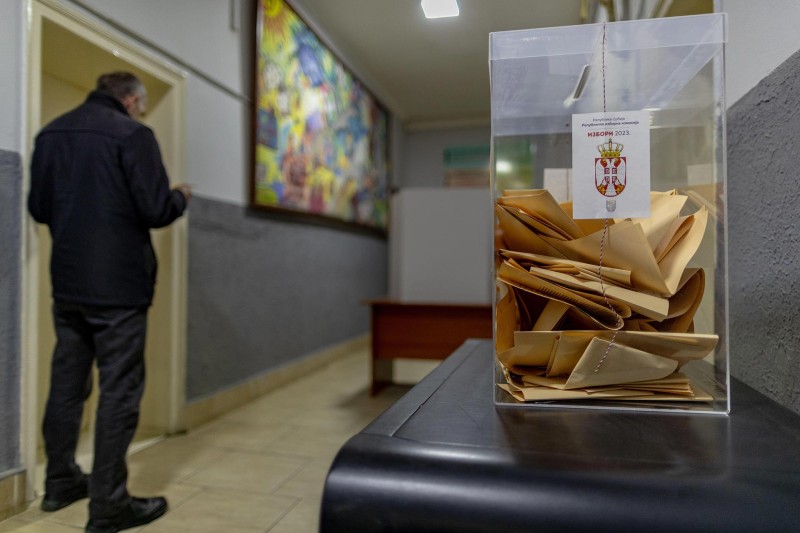

4
As in later Color Revolutions, the events in Serbia occurred in an environment where international organizations were supporting civil society initiatives.
Several organizations were involved in funding or supporting programs focused on:
• Election monitoring
• Independent media development
• Civic education
• Political organizing
These institutions included organizations such as:
• The National Endowment for Democracy (NED)
• The National Democratic Institute (NDI)
• The International Republican Institute (IRI)
• Various European democracy promotion programs
Some activists were also influenced by the writings of Gene Sharp, an American political theorist who developed theories of nonviolent resistance.
Sharp’s ideas emphasized how coordinated civil resistance could weaken authoritarian governments without the use of violence.
Supporters of these initiatives argue that they helped strengthen democratic institutions and citizen participation.
Critics argue that such programs sometimes serve broader geopolitical interests of Western governments.
Regardless of perspective, the Serbian uprising demonstrated how civil society networks, activist movements, and international attention could interact during moments of political crisis.
Media and the Information Battle
Another crucial factor in the revolution was the role of independent media and information networks.
During the Milošević era, many state-controlled media outlets supported the government.
However, several independent newspapers, radio stations, and television channels emerged that provided alternative perspectives.
Independent outlets reported extensively on:
• Allegations of election fraud
• Government corruption
• Protest movements across the country
International news networks also covered events in Serbia closely.
Images of student demonstrations, protest graffiti, and mass rallies spread across global media.
These images helped shape international perceptions of the uprising as a popular democratic movement challenging authoritarian leadership.
The information battle became a central part of the political struggle.
Public perception—both inside Serbia and internationally—played a major role in increasing pressure on the government.
October 5, 2000: The Bulldozer Revolution
4
The decisive moment came on October 5, 2000.
Hundreds of thousands of protesters converged on Belgrade, the capital of Serbia.
Workers from across the country traveled to the city to join the demonstrations.
Miners from the Kolubara coal basin, truck drivers, farmers, and students all participated.
One protester famously drove a bulldozer through the doors of the Serbian parliament building.
The dramatic image quickly spread through international media and gave the uprising its name: The Bulldozer Revolution.
Protesters occupied several government buildings.
Security forces largely refused to suppress the demonstrations.
Facing overwhelming pressure and the collapse of political support, Slobodan Milošević conceded defeat the following day.
Opposition leader Vojislav Koštunica became the new president.
The Beginning of the Color Revolution Era
The events in Serbia had a powerful influence on activists and political movements in other countries.
Members of Otpor later helped train activists involved in protest movements elsewhere.
These included movements such as:
• Georgia’s Rose Revolution (2003)
• Ukraine’s Orange Revolution (2004)
• Kyrgyzstan’s Tulip Revolution (2005)
Many of the strategies first used in Serbia became standard features of Color Revolutions.
These strategies included:
• Youth-led activist movements
• Strong symbolic branding and imagery
• Nonviolent protest tactics
• Media-focused demonstrations
• International election monitoring
• Civil society mobilization
Because of this influence, the Bulldozer Revolution is often viewed as the starting point of the modern Color Revolution model.
Serbia After the Revolution
Following Milošević’s fall, Serbia entered a period of political transformation.
The new government began pursuing reforms aimed at:
• Democratizing political institutions
• Rebuilding the economy
• Reintegrating Serbia into international institutions
In 2001, Milošević was arrested and transferred to The Hague to stand trial before the International Criminal Tribunal for the former Yugoslavia.
However, Serbia’s transition to democracy was not without difficulties.
The country faced challenges including:
• Political divisions among reformist leaders
• Economic restructuring
• Public dissatisfaction with the pace of reform
Nevertheless, the revolution marked a decisive break with the authoritarian political system of the 1990s.
Why the Serbian Revolution Matters
The Bulldozer Revolution remains one of the most important case studies in the history of modern protest movements.
It demonstrated how:
• Mass protests could challenge entrenched governments
• Youth movements could mobilize large segments of society
• Symbolic imagery could capture global attention
• Information networks could shape political outcomes
Most importantly, it created a model for nonviolent political uprisings that would later appear across multiple regions of the world.
In this sense, Serbia’s revolution did more than change its own government.
It helped launch a new era of political activism that would reshape global geopolitics in the decades that followed.
Next in the Series
The next article in this series will examine a wave of uprisings that spread across multiple countries:
🌍 The Arab Spring
Beginning in 2010, protest movements erupted across North Africa and the Middle East, toppling governments and triggering conflicts that still influence global politics today.
The Arab Spring revealed how social media, youth activism, economic frustration, and geopolitical rivalries could combine to produce one of the most dramatic periods of political upheaval in modern history.
Armenia Velvet revolution blog just as long
🇦🇲 Armenia: The Velvet Revolution and the Power of Civic Protest


4
The Velvet Revolution of 2018 in Armenia became one of the most significant political transformations in the country’s modern history.
Unlike some earlier Color Revolutions that were triggered by disputed elections, Armenia’s revolution emerged from widespread frustration with entrenched political leadership, corruption, and a controversial constitutional maneuver that many citizens believed was designed to keep the ruling elite in power indefinitely.
The movement ultimately forced the resignation of long-time political leader Serzh Sargsyan and brought opposition figure Nikol Pashinyan to power.
For supporters, the Velvet Revolution represented a peaceful democratic awakening driven by grassroots civic participation.
For critics, it raised questions about how protest movements, information networks, and geopolitical interests interact in countries positioned between major global powers.
What made Armenia’s revolution particularly notable was its almost entirely peaceful nature.
Mass demonstrations, road blockades, student strikes, and civil disobedience spread across the country without descending into widespread violence.
Because of this, the uprising became known as the “Velvet Revolution,” echoing earlier peaceful transitions in Eastern Europe.
Armenia’s Political Landscape After the Soviet Union
To understand the Velvet Revolution, it is necessary to examine Armenia’s political history following the collapse of the Soviet Union in 1991.
Armenia emerged as an independent state during a period of enormous regional turmoil.
One of the most defining issues facing the country was the conflict over Nagorno-Karabakh, a disputed territory between Armenia and neighboring Azerbaijan.
The conflict led to a brutal war during the early 1990s.
Although a ceasefire was eventually reached, tensions remained high and the region remained politically unstable.
Throughout the following decades, Armenia’s political system became dominated by a relatively small group of powerful political elites.
Several issues increasingly frustrated the public:
• Allegations of corruption within government institutions
• Concentration of political power among a small political class
• Economic stagnation and limited job opportunities
• Large-scale emigration of young Armenians seeking opportunities abroad
While Armenia maintained formal democratic institutions such as elections and political parties, many critics argued that the political system had become deeply entrenched and resistant to change.
By the mid-2010s, public dissatisfaction with the political establishment had grown significantly.
The Constitutional Crisis
The immediate trigger for the Velvet Revolution came in 2015, when Armenia held a national referendum on constitutional reform.
The proposed changes transformed Armenia from a presidential system into a parliamentary system.
Supporters of the reform argued that parliamentary governance would strengthen democratic institutions.
However, critics believed the reform had another purpose.
At the time, President Serzh Sargsyan was nearing the end of his second presidential term.
Under the constitution, he could not run for president again.
Opposition groups suspected that the constitutional reform was designed to allow Sargsyan to retain power by becoming prime minister after leaving the presidency.
When Sargsyan later announced that he would indeed seek the position of prime minister, many Armenians felt their suspicions had been confirmed.
The announcement triggered widespread anger.
Opposition politicians began calling for nationwide protests.
The Rise of the Protest Movement
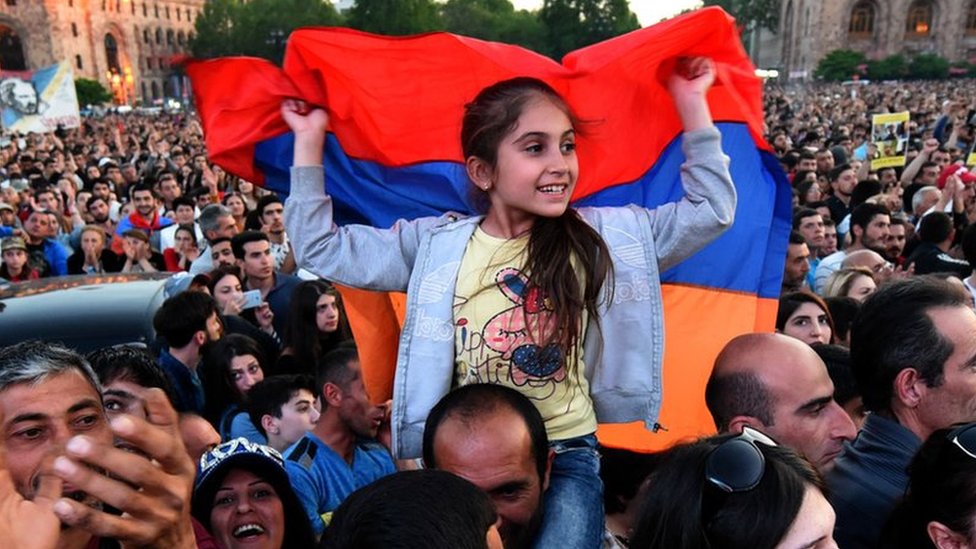

4
The protest movement was led by opposition politician Nikol Pashinyan, a former journalist who had become one of the most outspoken critics of Armenia’s ruling political establishment.
In April 2018, Pashinyan began a long protest march across the country.
The march symbolized a call for peaceful civic resistance against what protesters viewed as an attempt to extend political power indefinitely.
As the demonstrations spread, thousands of Armenians began participating in acts of nonviolent civil disobedience.
Protest tactics included:
• Blocking major roads and intersections
• Organizing student strikes
• Holding mass rallies in public squares
• Conducting peaceful marches across cities
Republic Square in the capital city of Yerevan became the central gathering place for the demonstrations.
Crowds of tens of thousands of people filled the square day after day.
One of the defining characteristics of the Velvet Revolution was the participation of ordinary citizens across many different sectors of society.
Students, workers, professionals, artists, and religious leaders all joined the protests.
The movement maintained a strong commitment to peaceful resistance.
Protesters frequently emphasized that their goal was political reform rather than violent confrontation.
Social Media and the Information Revolution


4
One of the most important factors in the success of the Velvet Revolution was the role of social media and digital communication networks.
Unlike earlier Color Revolutions that relied heavily on television coverage and traditional media, the Armenian protests were organized largely through online platforms.
Activists used platforms such as:
• Facebook
• Twitter
• YouTube
• Messaging applications
These tools allowed organizers to quickly coordinate demonstrations, share information, and mobilize supporters.
Nikol Pashinyan himself frequently used live video broadcasts on social media to communicate directly with citizens.
Through livestreams, he updated supporters on protest plans, encouraged peaceful participation, and responded to political developments in real time.
The use of social media allowed the protest movement to bypass traditional state-controlled information channels.
It also allowed the Armenian diaspora around the world to follow events closely and express support.
The Velvet Revolution therefore demonstrated how digital communication could dramatically expand the reach and speed of modern protest movements.
The Fall of Serzh Sargsyan


4
As the protests continued to grow, pressure on the Armenian government increased rapidly.
Attempts by authorities to suppress the demonstrations only fueled further public anger.
Thousands more citizens joined the protests across the country.
On April 23, 2018, after just days of massive demonstrations, Serzh Sargsyan announced his resignation as prime minister.
In a brief public statement, he acknowledged the power of the protest movement and admitted that he had misjudged the political situation.
His resignation marked a historic moment.
Shortly afterward, Armenia’s parliament elected Nikol Pashinyan as prime minister, completing the political transition.
The Velvet Revolution had achieved its central goal without a violent uprising.
NGOs, Civil Society, and Political Debate
As with other Color Revolutions, the Armenian uprising sparked debate about the role of civil society organizations and international actors.
Various international organizations had supported programs in Armenia related to:
• Democratic governance
• Election transparency
• Media development
• Civil society engagement
Institutions involved in these initiatives across the region included organizations such as:
• The Open Society Foundations, associated with George Soros
• The National Endowment for Democracy (NED)
• The National Democratic Institute (NDI)
• The International Republican Institute (IRI)
Supporters argue that these programs help strengthen democratic institutions and citizen participation.
Critics argue that external involvement in domestic political development can sometimes influence national political outcomes.
In the case of Armenia, most analysts agree that the driving force behind the Velvet Revolution was widespread domestic frustration with entrenched political leadership.
Armenia Between Global Powers
Armenia occupies a particularly complex geopolitical position.
The country maintains strong historical ties with Russia, which provides security guarantees and maintains a military base in Armenia.
At the same time, Armenia has also sought to maintain constructive relations with European institutions and Western governments.
Following the Velvet Revolution, many observers wondered whether Armenia would dramatically shift its foreign policy orientation.
However, the new government largely pursued a balanced approach, maintaining relations with both Russia and Western partners.
This balancing act reflects Armenia’s strategic position in a region influenced by multiple global powers.
Why the Velvet Revolution Matters
The Armenian Velvet Revolution stands out among modern political uprisings for several reasons.
First, it demonstrated the power of large-scale peaceful civic mobilization.
Second, it showed how social media and digital communication could play a decisive role in organizing mass protests.
Third, it illustrated how entrenched political systems can sometimes change rapidly when public frustration reaches a tipping point.
Unlike some other revolutions that led to prolonged instability or violent conflict, Armenia’s transition occurred remarkably quickly and with relatively little violence.
Because of this, the Velvet Revolution is often cited as one of the most successful examples of nonviolent political change in the modern era.
Armenia Today
In the years following the revolution, Armenia has continued to navigate complex challenges.
These include:
• Economic reform
• Political restructuring
• Regional security tensions
• The ongoing conflict with Azerbaijan over Nagorno-Karabakh
The political transformation of 2018 did not solve all of Armenia’s problems.
However, it significantly reshaped the country’s political landscape.
The Velvet Revolution remains a powerful symbol of how citizen participation and peaceful protest can transform a nation’s political direction.
Next in the Series
The next article in this series will explore a movement that shook Eastern Europe more recently:
🇧🇾 Belarus – The 2020 Protest Movement
Following a disputed presidential election, massive demonstrations erupted across Belarus, becoming one of the largest protest movements in the country’s history.
The events in Belarus would reveal how modern protest movements interact with authoritarian governments, digital media, and geopolitical tensions in the 21st century.
Do belarus
🇧🇾 Belarus: The 2020 Protest Movement and the Struggle Against an Entrenched Regime


4
The 2020 protest movement in Belarus became one of the largest political uprisings in Eastern Europe in the 21st century.
Although it was not officially named after a color like earlier movements such as the Rose Revolution, Orange Revolution, or Tulip Revolution, many analysts viewed the Belarus protests as part of the broader tradition of Color Revolution-style movements.
The demonstrations erupted after a highly disputed presidential election and quickly developed into a nationwide protest movement demanding political reform and new elections.
For supporters, the protests represented a popular uprising against an entrenched authoritarian government.
For critics, they raised questions about external political influence, international media narratives, and the geopolitical struggle between Russia and Western countries.
Unlike several earlier Color Revolutions that successfully replaced ruling governments, the Belarus protest movement ultimately faced heavy repression from the state, leading to one of the most intense political crackdowns in Europe in recent decades.
Belarus Under Alexander Lukashenko
To understand the events of 2020, it is necessary to examine the political system that had developed in Belarus over the previous quarter century.
Since 1994, Belarus had been ruled by Alexander Lukashenko, who became the country’s first president after the collapse of the Soviet Union.
Over the years, Lukashenko developed a political system that concentrated power heavily within the presidency.
His government maintained tight control over many aspects of public life, including:
• State media
• Major industries
• Security services
• Political institutions
Supporters of Lukashenko argued that his leadership brought stability and economic security compared to the chaotic transitions experienced by some other post-Soviet states.
Belarus maintained many features of the Soviet-era economic system, including a large state-controlled industrial sector.
However, critics argued that the country had become one of the most authoritarian political systems in Europe.
Opposition parties struggled to compete in elections, and many opposition leaders faced political pressure, arrests, or exile.
By the late 2010s, public dissatisfaction had grown among some segments of the population, particularly younger citizens who wanted greater political freedoms and economic opportunities.
The 2020 Presidential Election
The immediate trigger for the protest movement was the presidential election held on August 9, 2020.
Several opposition figures attempted to challenge Lukashenko’s long rule.
However, some potential candidates were arrested or prevented from running.
In response, the opposition rallied around a new figure: Sviatlana Tsikhanouskaya, the wife of an imprisoned opposition blogger.
Tsikhanouskaya entered the race as a unifying candidate for the opposition movement.
Her campaign quickly attracted large crowds across the country.
When the official election results were announced, authorities declared that Lukashenko had won more than 80 percent of the vote.
Opposition leaders and many citizens immediately rejected the results.
They accused the government of widespread election fraud.
The announcement triggered massive protests across Belarus.
The Rise of the Protest Movement


4
Within days of the election, tens of thousands of people began gathering in Minsk, the capital of Belarus, and in other cities across the country.
The protests quickly grew into the largest demonstrations in Belarusian history.
One of the most distinctive aspects of the movement was the strong participation of women activists.
Groups of women formed human chains of solidarity, standing in public spaces while dressed in white and carrying flowers.
These demonstrations became powerful visual symbols of peaceful resistance.
Workers from several major state-owned factories also joined the protests.
Strikes and walkouts occurred in key industrial sectors, including large manufacturing plants that had traditionally been strongholds of government support.
The demonstrations remained largely peaceful despite growing tensions between protesters and security forces.
Crowds marched through city streets carrying flags and banners calling for:
• New elections
• The release of political prisoners
• Political reform
One of the most prominent symbols of the movement was the white-red-white flag, a historic Belarusian national flag used before the Soviet era.
Social Media and the Information War


4
Like many modern protest movements, the Belarus demonstrations relied heavily on digital communication and social media platforms.
Messaging applications such as Telegram became essential tools for organizing protests and sharing information.
One of the most influential platforms was a Telegram channel called NEXTA, which published protest updates, videos, and instructions for demonstrators.
These channels allowed protesters to coordinate activities rapidly and avoid government attempts to control information.
Citizens used smartphones to record videos of demonstrations and police actions.
These videos spread quickly across the internet and international media.
At the same time, the Belarusian government attempted to limit the flow of information by temporarily shutting down internet access during key protest periods.
The information battle quickly expanded beyond Belarus.
International media outlets, government officials, and political organizations around the world followed the events closely.
The situation became part of a larger geopolitical narrative involving Russia, Europe, and the United States.
The Government Crackdown


4
The Belarusian government responded to the protests with a strong security crackdown.
Police and special security units used tactics such as:
• Mass arrests
• Riot control measures
• Detention of protest leaders
• Closure of independent media outlets
Thousands of protesters were detained during the demonstrations.
Many opposition figures were arrested or forced into exile.
Sviatlana Tsikhanouskaya herself eventually left the country and continued to advocate for political reform from abroad.
Despite the crackdown, protests continued for several months.
However, the government maintained control of the state apparatus, including the security forces and military.
By early 2021, the protest movement had largely been suppressed.
NGOs, Civil Society, and International Reactions
The Belarus protests also sparked debate about the role of civil society organizations and international political pressure.
Various organizations supporting democratic governance had been active in Belarus and neighboring countries for many years.
Institutions involved in such programs included organizations such as:
• The Open Society Foundations, associated with George Soros
• The National Endowment for Democracy (NED)
• The National Democratic Institute (NDI)
• The International Republican Institute (IRI)
Supporters argue that these organizations promote democratic participation and civic engagement.
Critics argue that such efforts can become entangled with broader geopolitical competition between global powers.
Western governments criticized the Belarus election and imposed sanctions against the Belarusian government.
Russia, on the other hand, expressed support for Lukashenko and warned against foreign interference in Belarusian affairs.
Belarus and the Russia–West Geopolitical Divide
Belarus occupies a strategically important position between Russia and the European Union.
The country has long maintained close political, economic, and military ties with Russia.
At the same time, some segments of Belarusian society have expressed interest in closer cooperation with European institutions.
The events of 2020 therefore became part of the broader geopolitical struggle between Russia and Western countries.
Russia provided political backing to the Belarusian government, helping stabilize Lukashenko’s position.
This support made it much more difficult for the protest movement to achieve a political transition similar to those seen in earlier Color Revolutions.
Why the Belarus Protests Matter
The Belarus protest movement highlighted several key realities about modern political uprisings.
First, it demonstrated the power of mass civic mobilization, with hundreds of thousands of people participating in demonstrations.
Second, it showed how digital communication platforms can rapidly organize protest movements.
Third, it illustrated the limits of protest movements when governments retain strong control over security forces and state institutions.
Unlike some earlier Color Revolutions, the Belarus movement did not result in an immediate change of leadership.
Instead, it revealed how authoritarian governments can maintain power even in the face of large-scale public demonstrations.
Belarus Today
Today, Belarus remains under the leadership of Alexander Lukashenko.
The political environment remains tightly controlled, and many opposition figures continue to operate from exile.
The events of 2020, however, left a lasting mark on Belarusian society.
They revealed the depth of political dissatisfaction among large segments of the population and demonstrated the growing role of digital networks in organizing political movements.
Even though the protests did not achieve immediate political change, they remain one of the most significant moments in Belarus’s modern political history.
Next in the Series
The next article in this series will explore a movement that reshaped politics across an entire region:
🌍 The Arab Spring
Beginning in Tunisia in 2010, a wave of uprisings spread across North Africa and the Middle East, toppling governments and triggering conflicts that continue to influence global politics today.
The Arab Spring would demonstrate how social media, economic frustration, youth activism, and geopolitical rivalries could combine to ignite revolutions across multiple countries almost simultaneously.
Do Moldova
🇲🇩 Moldova: The Twitter Revolution and the Struggle Between East and West


4
The 2009 protest movement in Moldova, often referred to as the “Twitter Revolution,” became one of the earliest political uprisings in Eastern Europe to be strongly associated with social media activism.
Although it did not officially carry a color-based name like the Rose Revolution in Georgia or the Orange Revolution in Ukraine, many analysts consider Moldova’s protests part of the broader wave of Color Revolution-style movements that spread across post-Soviet states during the early 2000s.
The demonstrations erupted after a disputed parliamentary election and quickly escalated into massive protests in the capital city of Chișinău.
For supporters, the protests represented a youth-led demand for democratic reform and closer ties with Europe.
For critics, the events raised questions about foreign influence, information warfare, and geopolitical competition between Russia and Western institutions.
The Moldovan protests also became notable for their connection to digital communication platforms, marking one of the earliest examples of how social media could help organize large-scale political demonstrations.
Moldova After the Soviet Union
To understand the 2009 protests, it is necessary to examine Moldova’s political history following the collapse of the Soviet Union.
Moldova became an independent country in 1991 after the dissolution of the USSR.
The country quickly faced several major challenges:
• Economic instability
• Political fragmentation
• Regional tensions
• Identity debates between Romanian and Moldovan national identity
One of the most significant conflicts occurred in the early 1990s when the eastern region of Transnistria declared independence.
The resulting conflict led to a brief war between Moldovan forces and separatist fighters supported by Russian troops.
Although the conflict ended with a ceasefire, Transnistria has remained a de facto separate territory ever since, supported politically and militarily by Russia.
This unresolved conflict has continued to shape Moldova’s politics and foreign policy.
Throughout the 2000s, Moldova remained one of the poorest countries in Europe, with many citizens leaving the country to work abroad.
Economic hardship and political dissatisfaction created fertile ground for protest movements.
The Communist Government
During the early 2000s, Moldova was governed by the Party of Communists of the Republic of Moldova, led by President Vladimir Voronin.
Despite the party’s name, the government operated within a multi-party political system and maintained diplomatic relations with both Russia and European institutions.
However, critics accused the government of:
• Restricting media freedom
• Manipulating elections
• Maintaining close ties with Russia
• Limiting political opposition
At the same time, a growing segment of Moldova’s younger population increasingly favored closer integration with the European Union.
These divisions created a political environment in which Moldova was often described as caught between East and West.
The 2009 Parliamentary Election
The immediate trigger for the protests occurred during the parliamentary elections held on April 5, 2009.
When the official results were announced, the Communist Party claimed victory with approximately 50 percent of the vote, giving it a majority in parliament.
Opposition parties and many citizens immediately questioned the legitimacy of the results.
They accused the government of voter fraud and manipulation of the electoral process.
Young activists and opposition groups began organizing protests in Chișinău.
Initially, the demonstrations were relatively small.
However, within a few days they expanded rapidly as thousands of citizens gathered in the city center.
The Rise of the Protest Movement


4
By April 7, the protests had grown dramatically.
Thousands of demonstrators filled the streets of Chișinău, gathering in front of government buildings including the parliament and presidential offices.
The demonstrations were driven largely by students and young activists, many of whom were frustrated with economic conditions and the lack of political opportunities.
Protesters carried flags and banners calling for:
• New elections
• Democratic reforms
• Greater political freedoms
Many demonstrators also waved European Union flags, symbolizing their desire for closer ties with Europe.
The protests initially remained peaceful.
However, tensions soon escalated.
Large crowds stormed government buildings, and parts of the parliament building were set on fire.
The dramatic scenes shocked the country and quickly attracted international attention.
Social Media and the “Twitter Revolution”
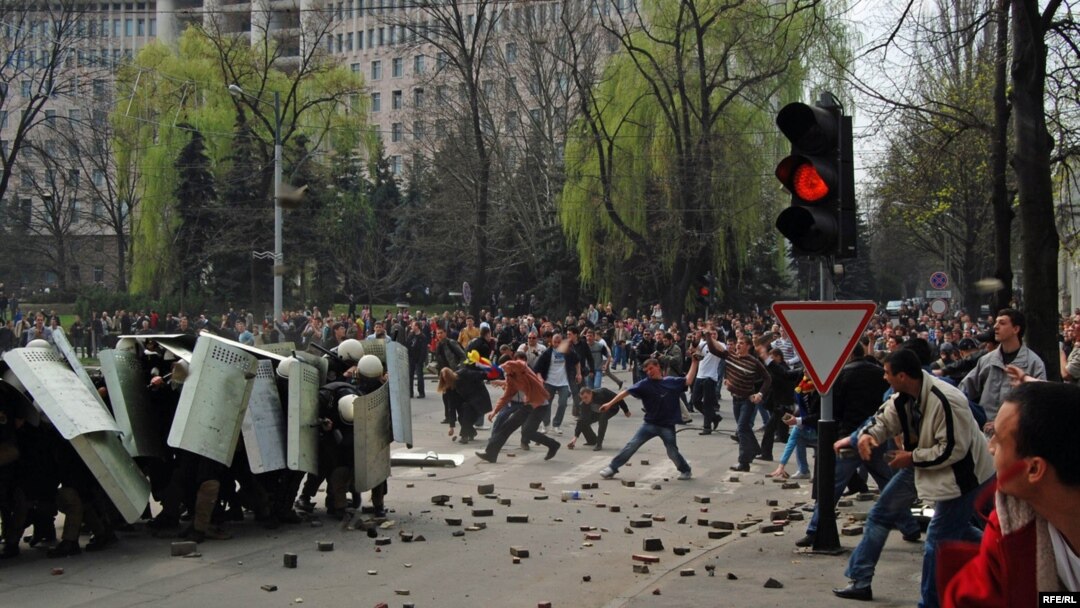

4
One of the most widely discussed aspects of the Moldovan protests was the role of social media and digital communication.
Young activists used platforms such as:
• Twitter
• Facebook
• Online forums
• Text messaging
These tools allowed demonstrators to rapidly organize protests and share information.
Because Twitter was particularly visible during the demonstrations, international media began referring to the events as the “Twitter Revolution.”
Although social media did not single-handedly cause the protests, it played an important role in accelerating the spread of information and mobilizing participants.
Images and videos of demonstrations spread quickly across the internet.
These visuals helped draw global attention to the unfolding political crisis.
The Moldovan protests therefore became one of the earliest examples of how digital communication technologies could influence political mobilization.
The Government Response

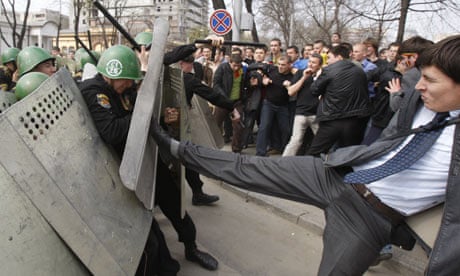
4
The Moldovan government responded to the unrest with a strong security crackdown.
Police forces moved to disperse demonstrators and regain control of government buildings.
Authorities arrested hundreds of protesters.
Opposition groups accused the government of using excessive force and mistreating detainees.
The political crisis deepened as both sides accused each other of escalating the situation.
Government officials claimed that the protests were influenced by foreign actors attempting to destabilize the country.
Opposition leaders argued that the demonstrations represented a legitimate popular uprising against electoral fraud.
NGOs, Civil Society, and International Debate
As with other Color Revolution-style movements, the events in Moldova sparked debate about the role of civil society organizations and international actors.
Various organizations promoting democratic governance had supported programs in Moldova related to:
• Election monitoring
• Media development
• Civic education
• Political transparency
Institutions involved in these initiatives across Eastern Europe included organizations such as:
• The Open Society Foundations, associated with George Soros
• The National Endowment for Democracy (NED)
• The National Democratic Institute (NDI)
• The International Republican Institute (IRI)
Supporters argue that such programs help strengthen democratic institutions.
Critics argue that external involvement can influence domestic political dynamics.
Regardless of these debates, the protests were largely driven by domestic political dissatisfaction and economic frustrations.
The Political Aftermath
The crisis eventually forced Moldova into a series of new elections.
The political landscape began to shift as opposition parties formed coalitions that challenged the long-standing Communist government.
By late 2009, a coalition of pro-European political parties known as the Alliance for European Integration had taken control of the government.
The new leadership pursued policies aimed at strengthening Moldova’s relationship with European institutions.
However, Moldova’s political environment remained unstable.
The country continued to experience:
• Political deadlock
• Government turnover
• Ongoing debates about relations with Russia and the European Union
Moldova Between East and West
Moldova occupies a sensitive geopolitical position between Russia and the European Union.
This position has made the country a frequent arena for political competition between different international influences.
Several key factors shape Moldova’s foreign policy debates:
• The unresolved status of Transnistria
• Economic ties with both Russia and Europe
• Cultural and historical connections with Romania
These issues continue to influence Moldova’s political direction.
Why the Moldova Protests Matter
The 2009 protests in Moldova became an important case study in the evolution of modern political movements.
They demonstrated several key features that would later appear in other uprisings:
• Youth-driven protest movements
• The rapid mobilization power of social media
• Political crises triggered by disputed elections
• The interaction between domestic protests and international geopolitical narratives
The protests also highlighted how information technologies were beginning to transform political activism.
Even though social media was still relatively new at the time, it played a visible role in spreading information and coordinating demonstrations.
Moldova Today
Today, Moldova continues to navigate a complex political landscape.
The country remains divided between competing visions for its future:
• Closer integration with the European Union
• Maintaining strong ties with Russia
Political reforms, economic challenges, and the unresolved status of Transnistria continue to shape the country’s future.
The events of April 2009 remain one of the most significant moments in Moldova’s modern political history.
They revealed how a combination of youth activism, digital communication, and political dissatisfaction could rapidly transform the political environment of a small but strategically important country.
Next in the Series
The next article in this series will explore a movement that triggered political upheaval across an entire region:
🌍 The Arab Spring
Beginning in Tunisia in 2010, a wave of uprisings spread across North Africa and the Middle East, toppling governments and triggering conflicts that still influence global politics today.
The Arab Spring would demonstrate how social media, economic frustration, youth activism, and geopolitical rivalries could combine to ignite revolutions across multiple countries almost simultaneously.
Do North Macedonia
🇲🇰 North Macedonia: The Colorful Revolution and the Fight Against Corruption

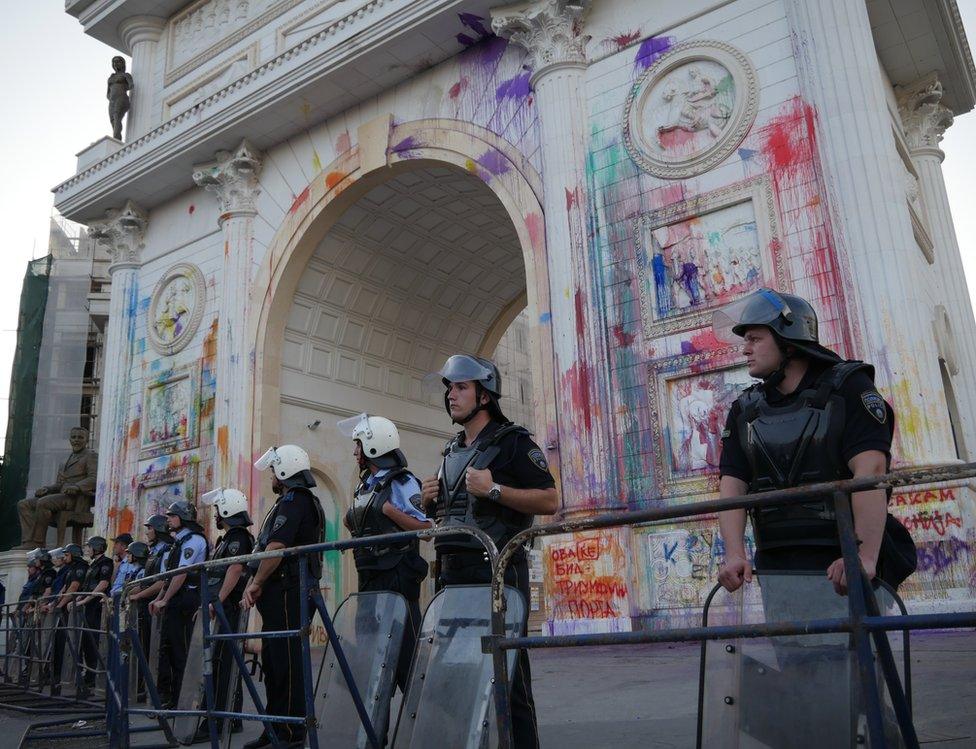

4
The Colorful Revolution in North Macedonia (2016–2017) became one of the most visually distinctive protest movements in Europe during the 21st century.
Unlike many earlier Color Revolutions that were named after flowers or colors used in political branding, the Macedonian movement gained its name from a unique tactic used by protesters: throwing brightly colored paint at government buildings and monuments.
The movement emerged during a deep political crisis triggered by corruption scandals, allegations of illegal surveillance, and disputes over democratic governance.
For supporters, the Colorful Revolution represented a citizen-led movement demanding accountability, transparency, and democratic reform.
For critics, the protests raised questions about external political influence, civil society activism, and geopolitical competition in the Balkans.
The uprising ultimately helped bring down a long-dominant political leadership and reshaped the country’s political direction, eventually contributing to the historic decision to rename the country North Macedonia as part of an international agreement with Greece.
Macedonia After the Yugoslav Breakup
When Yugoslavia dissolved in the early 1990s, the Republic of Macedonia declared independence in 1991.
Unlike several other Yugoslav republics, Macedonia avoided the large-scale wars that devastated parts of the Balkans.
However, the country still faced several major challenges.
These included:
• Economic instability following the collapse of the Yugoslav economy
• Political tensions between ethnic Macedonians and the Albanian minority
• Diplomatic disputes with neighboring Greece over the country’s name
• Weak institutions and corruption within government structures
The dispute with Greece became one of the most significant international challenges facing the country.
Greece objected to the use of the name “Macedonia,” arguing that it implied territorial claims over the Greek region with the same name.
As a result, the country was internationally referred to for many years as the Former Yugoslav Republic of Macedonia (FYROM).
Domestically, Macedonian politics gradually became dominated by two major parties:
• VMRO-DPMNE, a nationalist conservative party
• SDSM (Social Democratic Union of Macedonia), a center-left party
Political competition between these parties often became highly polarized.
The Rise of Nikola Gruevski
During the mid-2000s, the political landscape became dominated by Nikola Gruevski, leader of the VMRO-DPMNE party.
Gruevski served as prime minister from 2006 to 2016, making him one of the most powerful figures in modern Macedonian politics.
His government pursued policies aimed at:
• Economic growth
• National identity projects
• Infrastructure development
One of the most controversial initiatives was the “Skopje 2014” urban project, which involved constructing large monuments, statues, and classical-style buildings in the capital city.
Supporters argued that the project strengthened national identity.
Critics argued that it was expensive, politically motivated, and symbolic of growing government excess.
Over time, accusations of corruption and abuse of power began to mount against the government.
These accusations would eventually trigger one of the most significant political crises in the country’s history.
The Wiretapping Scandal
The immediate trigger for the Colorful Revolution came in 2015, when opposition leaders released recordings that they claimed revealed widespread government misconduct.
According to the opposition, the recordings showed that the government had illegally wiretapped more than 20,000 citizens, including journalists, politicians, and activists.
The recordings also allegedly exposed:
• Corruption within government institutions
• Manipulation of elections
• Political pressure on the judiciary and media
The revelations shocked the country and triggered a deep political crisis.
Opposition parties accused the government of undermining democratic institutions.
Large protests began to emerge across the country demanding accountability.
The Birth of the Colorful Revolution


4
In 2016, the protest movement evolved into what became known as the Colorful Revolution.
The name came from the movement’s signature tactic.
Protesters began throwing brightly colored paint at government buildings, statues, and monuments associated with the ruling party.
The paint symbolized public anger toward what protesters viewed as corruption and authoritarianism.
Some of the most prominent targets included monuments constructed under the controversial Skopje 2014 project.
The paint-covered statues became powerful visual symbols of the protest movement.
Crowds of demonstrators marched through the streets of Skopje, the capital city, calling for political reform.
Protesters demanded:
• The resignation of political leaders involved in the scandal
• Investigations into corruption allegations
• Free and fair elections
• Greater democratic transparency
The protests were largely peaceful, though tensions between demonstrators and police occasionally occurred.
Civil Society and Protest Organization


4
The Colorful Revolution was driven largely by civil society organizations, youth activists, and opposition political groups.
Activists organized demonstrations, rallies, and public gatherings throughout the country.
University students, journalists, artists, and professionals played a visible role in the movement.
The protests reflected a broader frustration among many citizens with what they viewed as growing authoritarian tendencies within the government.
International organizations promoting democratic governance had also supported programs in the region focused on:
• Media independence
• Civic engagement
• Election transparency
• Anti-corruption initiatives
Organizations involved in such efforts included institutions such as:
• The Open Society Foundations, associated with George Soros
• The National Endowment for Democracy (NED)
• The National Democratic Institute (NDI)
• The International Republican Institute (IRI)
Supporters argue that these initiatives help strengthen democratic institutions.
Critics argue that international involvement in domestic political development can sometimes influence national political outcomes.
Social Media and Information Networks


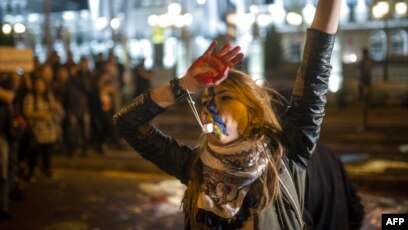
4
Like many modern protest movements, the Colorful Revolution relied heavily on social media and digital communication platforms.
Activists used platforms such as:
• Facebook
• Twitter
• YouTube
• Messaging applications
These platforms allowed organizers to:
• Coordinate protest routes and gathering points
• Share images and videos of demonstrations
• Spread information about political developments
• Mobilize participants quickly
Images of colorful paint splashed across government monuments spread rapidly across international media and social networks.
The visual symbolism helped the movement attract global attention.
As in other Color Revolutions, the information environment became a major arena of political contestation, with both government supporters and opposition activists attempting to shape public perception.
The Political Turning Point
The ongoing protests created enormous pressure on the Macedonian political system.
Negotiations between political parties eventually led to the Pržino Agreement, a political compromise designed to resolve the crisis.
Key elements of the agreement included:
• The resignation of Prime Minister Nikola Gruevski
• The formation of a transitional government
• New parliamentary elections
• Investigations into the wiretapping scandal
The elections held in 2016 produced a dramatic shift in the political landscape.
Opposition leader Zoran Zaev and the Social Democratic Union of Macedonia (SDSM) eventually formed a new government.
The long-dominant rule of VMRO-DPMNE had been broken.
The Name Change and International Agreements


4
One of the most historic consequences of the political shift was the Prespa Agreement of 2018 between Macedonia and Greece.
Under the agreement, the country officially changed its name to North Macedonia.
The compromise resolved a long-standing diplomatic dispute that had blocked the country’s membership in international organizations.
Following the agreement:
• North Macedonia joined NATO in 2020
• The country moved closer to European Union integration
Supporters viewed the agreement as a major diplomatic breakthrough.
Critics argued that the name change represented a loss of national identity.
Why the Colorful Revolution Matters
The Colorful Revolution became one of the most visually recognizable protest movements in Europe.
It demonstrated several important features of modern political uprisings:
• Symbolic protest tactics designed to attract media attention
• Strong participation from civil society organizations
• The growing importance of digital communication networks
• Political crises triggered by corruption scandals and institutional breakdown
The movement also highlighted how domestic political struggles can intersect with international geopolitical dynamics, particularly in regions where countries seek membership in Western institutions such as NATO and the European Union.
North Macedonia Today
Today, North Macedonia continues to navigate complex political and economic challenges.
The country has made progress toward integration with Western institutions, but it still faces issues including:
• Economic reform
• Political polarization
• Regional diplomacy
The Colorful Revolution remains one of the most important moments in the country’s recent history.
It showed how citizen mobilization, symbolic protest actions, and political negotiation could combine to reshape the direction of a nation.
Next in the Series
The next article in this series will explore a wave of revolutions that spread across an entire region:
🌍 The Arab Spring
Beginning in Tunisia in 2010, a series of uprisings spread rapidly across North Africa and the Middle East.
These movements would demonstrate how social media, economic frustration, youth activism, and geopolitical tensions could ignite revolutions across multiple countries in a matter of months.
Do the unsuccessful one in Russia
🇷🇺 Russia: The Unsuccessful Protest Movements and the Limits of a Color Revolution


4
Russia has experienced several large protest movements in the 21st century that some observers have described as attempted Color Revolutions.
However, unlike events in countries such as Georgia, Ukraine, or Armenia, these protest movements did not result in the overthrow of the government or a dramatic political transition.
Instead, they revealed the limits of protest movements in a political system where the state maintains strong control over institutions, security forces, and media networks.
The most significant of these movements occurred during the 2011–2012 protests, sometimes called the “White Ribbon Movement.”
Later waves of demonstrations, including protests in 2017, 2019, and 2021, also challenged the Russian government but ultimately failed to produce a change in leadership.
For supporters of the protests, these movements represented citizen demands for democratic reform and fair elections.
For critics within Russia’s leadership, they were viewed as Western-influenced attempts to destabilize the country through Color Revolution-style tactics.
The events highlight how modern protest movements interact with powerful state institutions, media control, and geopolitical narratives.
Russia’s Political System Under Vladimir Putin
To understand why Color Revolution-style movements struggled in Russia, it is necessary to examine the political system that developed after the collapse of the Soviet Union.
During the 1990s, Russia experienced a turbulent transition from communism to a market economy.
The decade was marked by:
• Economic collapse
• Political instability
• The rise of powerful oligarchs
• Regional conflicts such as the Chechen wars
In 2000, Vladimir Putin became president and began consolidating power within the Russian political system.
Over the following years, the government strengthened control over several key institutions:
• National television networks
• Security services
• Major industries
• Political parties
Supporters of Putin argued that his leadership restored stability and national strength after the chaotic 1990s.
Critics argued that Russia was evolving into a highly centralized political system with limited space for opposition movements.
These tensions would become more visible during the elections of 2011.
The 2011 Parliamentary Elections
The immediate trigger for the large protest movement came during the December 2011 parliamentary elections.
The ruling party, United Russia, won a majority of seats in parliament.
However, many opposition groups and independent observers accused the government of widespread election fraud.
Videos and reports of alleged irregularities circulated rapidly on the internet.
Anger spread quickly among politically active citizens, particularly in major cities such as Moscow and Saint Petersburg.
Soon, thousands of people began gathering in the streets to protest the election results.
These demonstrations became the largest protest movement in Russia since the collapse of the Soviet Union.
The White Ribbon Movement


4
The protest movement soon adopted the white ribbon as its symbol.
The ribbon represented the movement’s call for clean elections and political transparency.
Large demonstrations took place in Bolotnaya Square and other areas of Moscow, where crowds of tens of thousands gathered to protest.
Participants included:
• Students
• Journalists
• Professionals
• Artists
• Opposition politicians
Protesters carried banners calling for:
• New elections
• Political reforms
• Greater government accountability
The demonstrations were largely peaceful and resembled many of the civic protest movements seen in earlier Color Revolutions.
However, the Russian government interpreted the protests very differently.
Officials warned that foreign actors might be attempting to provoke a Color Revolution-style uprising similar to those that had occurred in other post-Soviet states.
Social Media and the Digital Protest Network

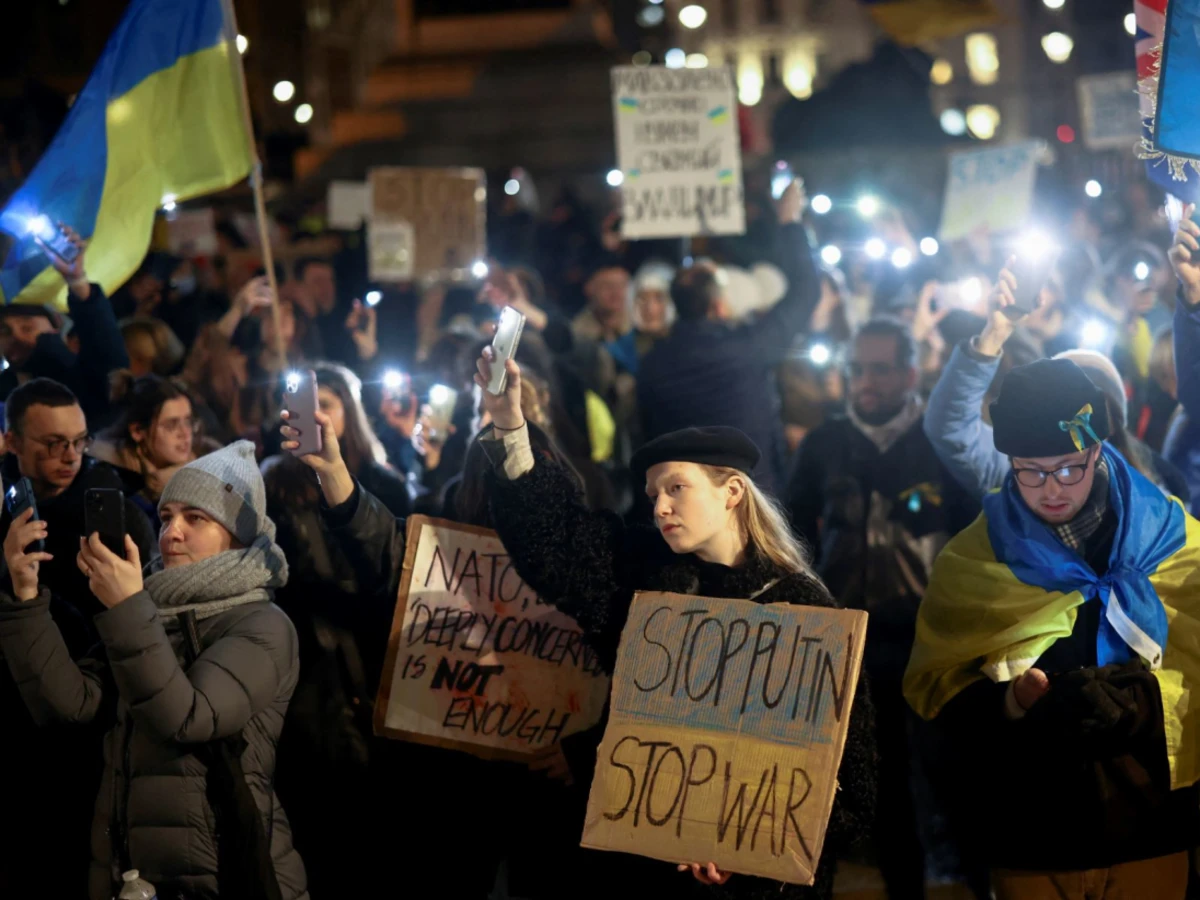

4
Like many modern protest movements, the Russian demonstrations relied heavily on digital communication networks.
Social media platforms played an important role in spreading information about alleged election fraud and organizing demonstrations.
Activists used platforms such as:
• Twitter
• Facebook
• LiveJournal
• YouTube
These platforms allowed protesters to share videos, photographs, and eyewitness reports from demonstrations.
Bloggers and independent journalists became influential voices within the movement.
Some of the most prominent opposition figures also used social media to communicate directly with supporters.
The internet therefore became a central arena for political debate and activism.
However, the government also began developing strategies to monitor and regulate digital communication spaces, recognizing their growing influence on political mobilization.
Opposition Figures and Political Leadership
Several opposition leaders became prominent during the protest movement.
One of the most visible figures was Alexei Navalny, an anti-corruption activist who gained popularity through online investigations into government corruption.
Navalny and other opposition figures helped mobilize protest supporters and attract international attention.
However, the Russian opposition remained fragmented, with multiple political factions representing different ideological perspectives.
Some activists supported liberal democratic reforms, while others represented nationalist or socialist viewpoints.
This lack of unity made it difficult for the opposition movement to develop a single political strategy capable of challenging the ruling government.
The Government Response


4
The Russian government responded to the protests with a combination of security measures and political reforms.
Authorities allowed some demonstrations to occur but also deployed police forces to control large gatherings.
Several protest leaders and participants were arrested.
New laws were introduced that increased penalties for unauthorized demonstrations.
At the same time, the government pursued policies aimed at strengthening control over political organizations and foreign-funded NGOs.
Officials argued that such measures were necessary to protect Russia from foreign interference.
Critics argued that the policies restricted political freedoms and limited opposition activity.
NGOs, Civil Society, and the Foreign Influence Debate
The protests also intensified debate within Russia about the role of foreign-funded civil society organizations.
Some organizations promoting democratic governance and civil society development had operated in Russia for many years.
Institutions involved in such programs internationally include organizations such as:
• The Open Society Foundations, associated with George Soros
• The National Endowment for Democracy (NED)
• The National Democratic Institute (NDI)
• The International Republican Institute (IRI)
Russian authorities expressed concern that some NGOs might serve as channels for external political influence.
In response, the government introduced laws requiring certain foreign-funded organizations to register as “foreign agents.”
These measures significantly changed the environment for civil society activism within the country.
Why the Protest Movement Failed
The Russian protest movement ultimately did not produce a political transition similar to earlier Color Revolutions.
Several factors contributed to this outcome:
Strong State Institutions
The Russian government maintained strong control over the security services, political institutions, and key media outlets.
Fragmented Opposition
Opposition groups lacked unified leadership and a shared political program.
Public Opinion Divisions
While many citizens supported the protests, others remained loyal to the government or feared instability similar to the chaotic 1990s.
Geopolitical Narratives
Government messaging framed the protests as potential foreign-backed attempts to destabilize Russia.
These factors limited the ability of the protest movement to gain enough momentum to challenge the political system.
Later Protest Waves
Although the 2011–2012 demonstrations gradually faded, additional protest movements emerged in later years.
These included:
• 2017 anti-corruption protests organized by opposition activists
• 2019 protests in Moscow over local election candidates
• 2021 demonstrations following the arrest of opposition figures
Each wave reflected continuing political tensions within Russian society.
However, none of these movements succeeded in producing major changes in national leadership.
Why the Russian Case Matters
The Russian protests highlight an important dimension of the study of Color Revolutions.
They show that large protest movements do not always succeed in producing political transformation.
In political systems where governments maintain strong control over institutions and security forces, protest movements face significant challenges.
Russia therefore represents an example of an attempted Color Revolution that did not succeed.
Russia Today
Today, Russia remains under the leadership of Vladimir Putin, who has served as president or prime minister since 2000.
The political system continues to emphasize strong centralized authority and national stability.
At the same time, debates about political reform, corruption, and civil liberties continue within Russian society.
The protests of the 2010s remain an important chapter in Russia’s modern political history.
They revealed the growing role of digital communication networks, civil society activism, and information narratives in shaping political movements in the 21st century.
Next in the Series
The next article in this series will explore the first uprising that triggered a wave of revolutions across an entire region:
🇹🇳 Tunisia – The Spark of the Arab Spring
Beginning in 2010, protests in Tunisia rapidly spread across North Africa and the Middle East.
The uprising would demonstrate how economic frustration, youth activism, social media, and political repression could combine to ignite one of the most dramatic waves of political upheaval in modern history.
Do the Arab Spring
🌍 The Arab Spring: A Wave of Revolutions Across the Middle East and North Africa


4
The Arab Spring was one of the most dramatic waves of political upheaval in the modern era.
Beginning in 2010, a series of protests and uprisings spread rapidly across North Africa and the Middle East, challenging governments that had ruled their countries for decades.
Within just a few years, the Arab Spring led to:
• The overthrow of several long-standing governments
• Civil wars in multiple countries
• Major geopolitical conflicts that continue to affect the world today
For supporters, the Arab Spring represented a historic push for freedom, democratic reform, and economic opportunity.
For critics, the uprisings revealed how political instability, regional rivalries, information warfare, and international intervention could destabilize entire regions.
The events of the Arab Spring demonstrated how modern protest movements, digital communication networks, and geopolitical competition can combine to produce rapid political transformation across multiple countries simultaneously.
Conditions That Led to the Arab Spring
Before the Arab Spring began, many countries in the Middle East and North Africa had been ruled by authoritarian governments for decades.
Several long-standing leaders included:
• Zine El Abidine Ben Ali in Tunisia (since 1987)
• Hosni Mubarak in Egypt (since 1981)
• Muammar Gaddafi in Libya (since 1969)
• Bashar al-Assad in Syria (since 2000, succeeding his father)
• Ali Abdullah Saleh in Yemen (since 1978)
Although these governments differed in ideology and structure, many shared common characteristics:
• Strong centralized authority
• Limited political freedoms
• Restrictions on opposition parties
• Control over media and public institutions
At the same time, the region faced serious social and economic challenges.
These included:
• High unemployment, particularly among young people
• Rising food prices
• Widespread corruption
• Limited economic opportunities
• Growing frustration with political elites
The Middle East also had one of the youngest populations in the world, with millions of young people entering the workforce each year.
Many of these young citizens felt that their governments offered little hope for economic advancement or political participation.
These tensions created the conditions for widespread unrest.
Tunisia: The Spark That Ignited the Arab Spring


4
The Arab Spring began in Tunisia in December 2010.
The immediate trigger was a tragic incident involving a young street vendor named Mohamed Bouazizi.
Bouazizi made a living selling fruit and vegetables from a small cart.
After local officials confiscated his goods and reportedly mistreated him, he set himself on fire in protest.
The act shocked the country.
News of the incident spread quickly through social media, television networks, and word of mouth.
Soon, protests erupted across Tunisia.
Demonstrators called for:
• Economic reforms
• Government accountability
• An end to corruption
Within weeks, the protests grew into a nationwide uprising.
In January 2011, President Zine El Abidine Ben Ali fled the country after 23 years in power.
Tunisia became the first government to fall during the Arab Spring.
Egypt and the Tahrir Square Revolution


4
The success of the Tunisian uprising quickly inspired protests across the region.
One of the largest and most influential movements occurred in Egypt.
In January 2011, massive demonstrations erupted in Cairo’s Tahrir Square.
Hundreds of thousands of protesters gathered to demand the resignation of President Hosni Mubarak, who had ruled Egypt for nearly thirty years.
Protesters called for:
• Democratic reforms
• Free elections
• Economic opportunities
• The end of corruption
The demonstrations continued for weeks despite clashes with security forces.
Eventually, the Egyptian military withdrew its support for Mubarak.
On February 11, 2011, Mubarak resigned.
The fall of Mubarak marked one of the most dramatic moments of the Arab Spring.
Libya: From Protest to Civil War


4
In Libya, protests against the government of Muammar Gaddafi began in early 2011.
Unlike Tunisia and Egypt, however, the Libyan uprising quickly escalated into a full-scale civil war.
Rebel forces seized control of parts of the country.
Government forces responded with military action.
The conflict soon attracted international attention.
In March 2011, a NATO-led coalition launched air strikes against Libyan government forces, supporting the rebel movement.
After months of fighting, rebel forces captured the capital city of Tripoli.
Later that year, Muammar Gaddafi was killed, bringing an end to his 42-year rule.
However, Libya’s political system collapsed following the war.
The country descended into prolonged instability and conflict among rival factions.
Syria: The Conflict That Became a Global War


4
In Syria, protests against the government of Bashar al-Assad began in 2011.
Demonstrations initially called for political reforms and greater freedoms.
However, the Syrian government responded with a severe crackdown.
The situation quickly escalated into a full-scale civil war.
The Syrian conflict became one of the most complex wars of the 21st century.
Multiple actors became involved, including:
• Syrian government forces
• Rebel factions
• Islamist militant groups
• Kurdish forces
• Foreign governments and military alliances
The war produced one of the largest humanitarian crises in modern history.
Millions of people were displaced or forced to flee the country.
Social Media and the Digital Revolution


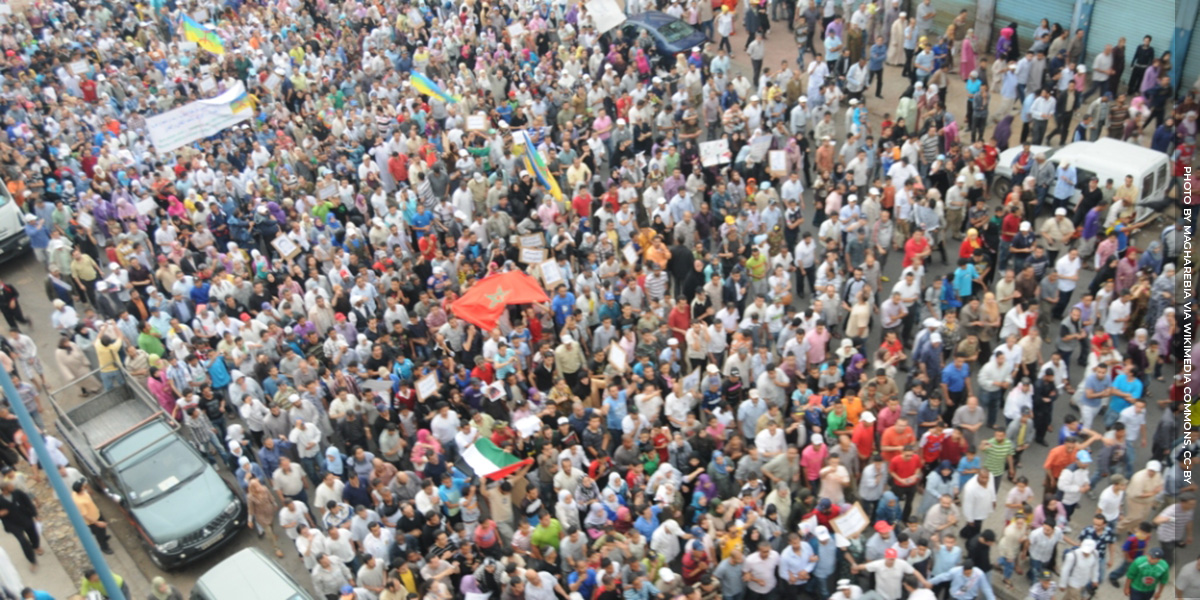
4
One of the defining features of the Arab Spring was the role of digital communication technologies.
Social media platforms such as:
• Facebook
• Twitter
• YouTube
• Messaging applications
became essential tools for organizing protests and spreading information.
Activists used these platforms to:
• Coordinate demonstrations
• Share videos and photographs
• Communicate with supporters
• Attract international media attention
Because of this, some commentators referred to the Arab Spring as a “Facebook Revolution” or “Social Media Revolution.”
Although social media did not cause the uprisings by itself, it helped accelerate the spread of protest movements across national borders.
NGOs, Media Narratives, and International Debate
As with earlier Color Revolutions, the Arab Spring sparked debate about the role of civil society organizations, foreign governments, and international media.
Various organizations promoting democratic governance had supported programs in the region related to:
• Civic education
• Media development
• Political transparency
• Election monitoring
Institutions involved in such initiatives internationally include organizations such as:
• The Open Society Foundations, associated with George Soros
• The National Endowment for Democracy (NED)
• The National Democratic Institute (NDI)
• The International Republican Institute (IRI)
Supporters argue that these programs encourage democratic participation.
Critics argue that such initiatives can intersect with broader geopolitical competition between global powers.
At the same time, international media coverage played a major role in shaping global perceptions of the uprisings.
The Outcomes of the Arab Spring
The results of the Arab Spring varied widely from country to country.
Some governments fell quickly.
Others survived the protests.
Several countries experienced prolonged conflict.
Major outcomes included:
• Tunisia – political reforms and democratic transition
• Egypt – government change followed by military takeover
• Libya – civil war and long-term instability
• Syria – ongoing civil war and humanitarian crisis
• Yemen – prolonged conflict and humanitarian disaster
These differing outcomes demonstrated that revolutions do not always produce stable political systems.
Why the Arab Spring Matters
The Arab Spring reshaped the political landscape of the Middle East and North Africa.
It demonstrated the power of:
• Mass protest movements
• Youth activism
• Digital communication networks
• Rapid information sharing across borders
At the same time, it revealed the risks of political upheaval in regions where state institutions are fragile and geopolitical rivalries are intense.
The consequences of the Arab Spring continue to influence global politics today.
The Legacy of the Arab Spring
More than a decade later, the effects of the Arab Spring are still unfolding.
Some countries have moved toward political reform.
Others remain trapped in cycles of conflict and instability.
The events of 2010–2011 remain one of the most important moments in modern political history.
They showed how a single protest in one country could ignite a chain reaction of uprisings across an entire region, reshaping international politics in ways that continue to reverberate around the world today.
If you'd like, I can also help you write the final concluding blog for your entire Color Revolution series, tying together Serbia → Georgia → Ukraine → Kyrgyzstan → Lebanon → Armenia → Belarus → Moldova → North Macedonia → Russia → Arab Spring into one big analysis of the pattern.
Do Tunisia
🇹🇳 Tunisia: The Revolution That Sparked the Arab Spring


4
The Tunisian Revolution of 2010–2011 marked the beginning of what would later become known as the Arab Spring—a wave of protests and uprisings that spread across the Middle East and North Africa.
The revolution began as a local protest against corruption and economic hardship but quickly developed into a nationwide movement demanding political reform, economic opportunity, and the end of authoritarian rule.
Within weeks, the protests forced the resignation of President Zine El Abidine Ben Ali, who had ruled Tunisia for more than two decades.
For many observers, Tunisia became the most successful example of political change to emerge from the Arab Spring, at least in its early years.
For others, the events illustrated how economic frustration, youth activism, digital communication networks, and political mobilization can rapidly destabilize entrenched governments.
The Tunisian uprising also demonstrated how one country’s revolution could ignite political movements across an entire region.
Tunisia Under Ben Ali
To understand the revolution, it is important to examine the political system that existed in Tunisia before the uprising.
Zine El Abidine Ben Ali came to power in 1987 after removing Tunisia’s founding president, Habib Bourguiba, in what was described as a peaceful political transition.
During the early years of his rule, Ben Ali presented himself as a reformer.
His government implemented policies aimed at:
• Economic modernization
• Expansion of tourism
• Development of infrastructure
• Strengthening relations with Western countries
Tunisia experienced periods of economic growth and relative stability compared with some neighboring countries.
However, over time, the political system became increasingly authoritarian.
Critics accused the government of:
• Restricting political opposition
• Controlling the media
• Limiting civil liberties
• Maintaining widespread corruption within the ruling elite
Many Tunisians also believed that members of the president’s extended family had gained significant control over major sectors of the economy.
These perceptions fueled growing public frustration.
Economic Frustration and Youth Unemployment
Despite economic growth in some sectors, many Tunisians struggled with serious economic challenges.
One of the most significant issues was high unemployment among young people, including university graduates.
Many young Tunisians found it difficult to obtain stable employment even after completing their education.
Other economic problems included:
• Rising food prices
• Regional inequality between urban and rural areas
• Limited opportunities for entrepreneurship
• Government bureaucracy and corruption
By the late 2000s, these frustrations had created widespread dissatisfaction among many citizens.
However, Tunisia’s political environment made open criticism of the government difficult.
Public protest movements were rare and often suppressed.
That situation would change dramatically in December 2010.
The Tragedy of Mohamed Bouazizi


4
The immediate spark of the Tunisian Revolution was a tragic event involving a young street vendor named Mohamed Bouazizi.
Bouazizi lived in the town of Sidi Bouzid, where he sold fruit and vegetables from a small cart.
Street vending was a common way for many Tunisians to earn a living, particularly in poorer regions.
According to widely reported accounts, Bouazizi had frequent conflicts with local officials who accused him of operating without the proper permits.
In December 2010, authorities confiscated his goods and reportedly mistreated him during an encounter.
Frustrated and humiliated, Bouazizi set himself on fire in front of a government building in protest.
The act shocked the country.
News of the incident spread quickly through social networks, mobile phones, and satellite television channels.
Within days, protests erupted in Sidi Bouzid.
The Spread of the Protest Movement


4
The protests that began in Sidi Bouzid quickly spread to other towns and cities across Tunisia.
Demonstrators expressed anger over:
• Unemployment
• Corruption
• Economic inequality
• Police abuse
• Political repression
As the protests grew, participants began demanding not only economic reforms but also the resignation of President Ben Ali.
Large demonstrations erupted in the capital city of Tunis, particularly along Avenue Habib Bourguiba, one of the country’s most prominent public spaces.
Protesters chanted slogans calling for freedom, dignity, and political change.
Despite attempts by security forces to suppress the demonstrations, the protests continued to grow.
Trade unions, lawyers, students, and professionals all began participating in the movement.
The uprising had transformed into a nationwide political revolution.
Social Media and Information Networks


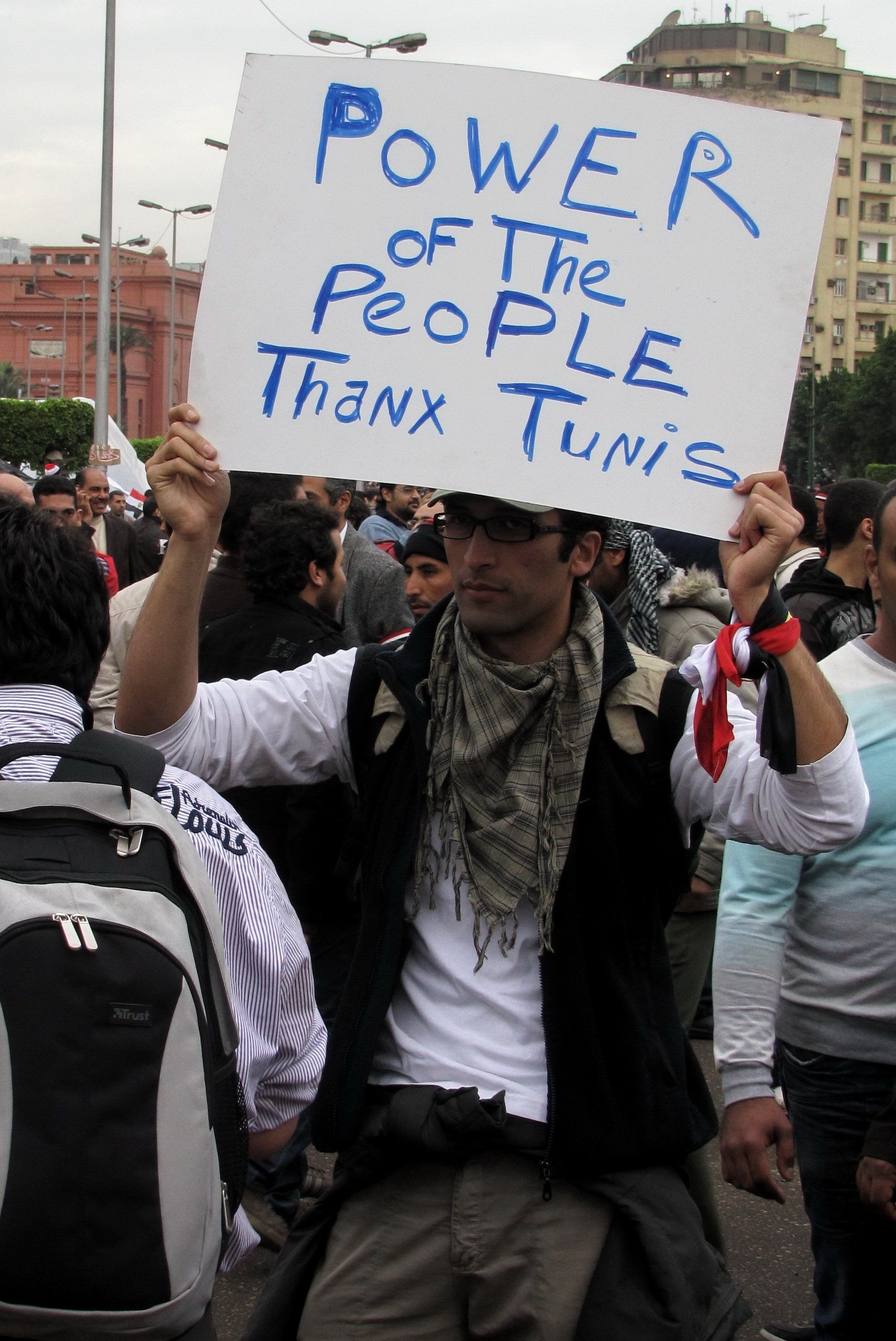
4
One of the defining features of the Tunisian Revolution was the role of digital communication networks.
Although Tunisia had relatively strict media controls, citizens were able to share information through:
• Facebook
• Twitter
• YouTube
• Mobile phone videos
Videos of protests and clashes with police circulated widely on the internet.
These images helped raise awareness both inside Tunisia and internationally.
Satellite television networks such as Al Jazeera also played a major role in broadcasting the protests to audiences across the Arab world.
The rapid spread of information helped transform a local protest into a national uprising within a matter of weeks.
The Fall of Ben Ali


4
As the demonstrations continued, pressure on the Tunisian government intensified.
Security forces attempted to restore order, but the protests continued to grow.
By January 2011, the political situation had reached a breaking point.
On January 14, 2011, President Zine El Abidine Ben Ali fled Tunisia, ending his 23-year rule.
The event marked one of the most dramatic political transformations in modern Middle Eastern history.
Tunisia had become the first country where the Arab Spring successfully overthrew a long-standing government.
Tunisia’s Political Transition
Following Ben Ali’s departure, Tunisia entered a complex political transition.
The country began drafting a new constitution and organizing democratic elections.
Political parties that had previously been banned were allowed to participate in public life.
Several key developments followed:
• Free elections were held in 2011
• A new constitution was adopted in 2014
• Coalition governments formed between multiple political parties
Tunisia was widely viewed as the most successful democratic transition to emerge from the Arab Spring.
However, the country still faced significant challenges.
These included:
• Economic difficulties
• Political polarization
• Security concerns related to extremist groups
Why the Tunisian Revolution Matters
The Tunisian Revolution holds a unique place in modern political history.
It demonstrated how a single act of protest could ignite a nationwide movement for political change.
It also showed how economic frustration, youth activism, and digital communication networks can rapidly transform political movements.
Perhaps most importantly, Tunisia’s uprising sparked a chain reaction across the Middle East and North Africa.
Within months, similar protests appeared in:
• Egypt
• Libya
• Syria
• Yemen
• Bahrain
This regional wave of uprisings became known as the Arab Spring.
Tunisia Today
More than a decade after the revolution, Tunisia continues to navigate the complex challenges of political reform and economic development.
The country remains one of the few examples where the Arab Spring produced lasting political transformation rather than prolonged conflict.
However, debates about governance, economic opportunity, and political stability continue.
The Tunisian Revolution remains a powerful example of how grassroots protest movements can reshape the political future of a nation—and sometimes an entire region.
Related Articles
Similar Tags
- 🌍🎨Color Revolution Series Part 11 ☪︎ The Arab Spring Part 1: A Wave of Revolutions Across the Middle East and North Africa
- ☪︎ The Arab Spring Part 3 🇪🇬 Egypt: The Tahrir Square Revolution and the Turning Point of the Arab Spring
- ☪︎ The Arab Spring Part 4 🇱🇾 Libya: The Uprising That Toppled Gaddafi and Opened the Door to Chaos
- ☪︎ The Arab Spring Part 5 🇸🇾 Syria: From Protest to One of the World’s Most Devastating Wars
- ☪︎ The Arab Spring Part 6 🇾🇪 Yemen: The Revolution That Became a Regional War
- ☪︎ The Arab Spring Part 7 🇧🇭 Bahrain: The Uprising at Pearl Roundabout and the Revolution That Was Contained
- ☪︎ The Arab Spring Part 8 🇲🇦 Morocco: The February 20 Movement and Reform Without Revolution
- ☪︎ The Arab Spring Part 9 🇯🇴 Jordan: The Protests That Pressured Reform Without Toppling the Monarchy
- ☪︎ The Arab Spring Part 10 🇩🇿 Algeria: Protest Without Revolution and the Shadow of a Civil War
- ☪︎ The Arab Spring Part 11 🇴🇲 Oman: Economic Protests and Reform Without Revolution
- ☪︎ The Arab Spring Part 12 🇰🇼 Kuwait: Parliament Stormed and Reform Within the System
- ☪︎ The Arab Spring Part 13 🇮🇶 Iraq: Protests Amid Instability and the Unfinished Struggle for Reform
- ☪︎ The Arab Spring Part 14 🇸🇦 Saudi Arabia: The Arab Spring That Never Fully Took Hold
- ☪︎ The Arab Spring Part 15 🇩🇯 Djibouti: The Small Uprising on the Edge of the Arab Spring
- 🌍🔥 From Color Revolutions to the Arab Spring: A Global Pattern of Modern Uprisings🌍🎨Color Revolution Series Part 26 | ☪︎ The Arab Spring Part 16
- 🌍🎨Color Revolution Series Part 1 — 🇺🇦 Ukraine: The Orange Revolution, Euromaidan, and the Road to War
- 🌍🎨Color Revolution Series Part 2 — 🇬🇪 Georgia: The Rose Revolution and the Reorientation of a Nation
- 🌍🎨Color Revolution Series Part 3 🇦🇲 Armenia: The Velvet Revolution and the Power of Peaceful Change
- 🌍🎨Color Revolution Series Part 4 🇰🇬 Kyrgyzstan: The Tulip Revolution and the Cycles of Power in Central Asia
- 🌍🎨Color Revolution Series Part 5 🇱🇧 Lebanon: The Cedar Revolution and the Struggle for Sovereignty
- 🌍🎨Color Revolution Series Part 6 🇷🇸 Serbia: The Bulldozer Revolution and the Birth of the Color Revolution Model
- 🌍🎨Color Revolution Series Part 7 🇧🇾 Belarus: The 2020 Protest Movement and the Struggle Against an Entrenched Regime
- 🌍🎨Color Revolution Series Part 8 🇲🇩 Moldova: The Twitter Revolution and the Struggle Between East and West
- 🌍🎨Color Revolution Series Part 9 🇲🇰 North Macedonia: The Colorful Revolution and the Fight Against Corruption
- 🌍🎨Color Revolution Series Part 10 🇷🇺 Russia: The Unsuccessful Protest Movements and the Limits of a Color Revolution
Popular Tags
- country
- countries
- Europe
- Africa
- Asia
- Kingdom Nations
- territories
- territory
- North America
- Oceania
- United States of America
- United States
- USA
- America
- US
- state
- states
- South America
- Color Revolutions
- United Kingdom
- UK
- Culture Survival
- Central America
- psychology
- Arab Spring
- British Overseas Territory
- truth
- spirituality
- protest
- protests
- Cognitive dissonance
- echo chamber
- echo chambers
- psychologist
- psychological
- France
- bible
- biblical
- Christian
- perception
- perceptions
- French Overseas Territory
- Australia
- Indonesia
- Christianity
- spiritual
- psychologists
- constituent country
- constituent countries
- Netherlands
Search
Subscribe
Donate
$
$


Your Statistics
For the care and safety of this prayer space, we gently record the time and location of each visit. This helps us protect sincerity while preserving anonymity.
Your Date and Time
IP Addres:
216.73.216.29
System
- OS Linux n
- PHP 8.3.30
- MySQLi 10.6.25-MariaDB-log
- Time 17:46
- Caching Disabled
- Gzip Disabled
- Users 10
- Articles 315
- Articles View Hits 6347
Website Visitors Map
About Greg Loucks
Greg Loucks is a writer, poet, filmmaker, musician, and graphic designer, as well as a creative visionary and faith-driven storyteller working at the intersection of language, meaning, and human connection. Born and raised in Phoenix, Arizona, he has lived in Cincinnati, Ohio; Hot Springs, Arkansas; Williams, Arizona; and Flagstaff, Arizona—each place shaping his perspective, resilience, and creative voice.

Address:
United States of America and Europe
Phone Numbers:
Arizona: (928) 563-GREG (4734)
Tennessee: (615) 899-GREG (4734)
Toll-Free: 888-457-GREG (4734)
Emails:
Open menu
- 🏠 Home
- ❓ About
- 🧑 Greg Loucks
- 📝 Testimony
- 📚 Categories
- 🗓️ Calendar
- 🪶 Poetry
- 📝 Blogs
- 🎙️ Podcast
- 📱 Social
- 📌 Forum
- 🔊 Messages
- 📷 Photos
- 🎥 Video
- 💼 Business
- ✝ Ministry
- 🌐 Network
- 🌍 Geography
- 📜 History
- 🔭 Science
- 🧬 Life
- 🤖 Technology
- 🐶 Dogs
- 🚗 Cars
- 🎮 Games
- 🪄 Magic
- 🤹 Juggling
- 🪀 Yo-Yo
- 🎈 Balloons
- 🛞 Unicycling
- 🎨 Art
- 📻 Radio
- 📺 Television
- 🎬 Movies
- 🎵 Music
- 🍔 Food
- 💳 Donate
- 🛒 Store
- 🤝 Help
- 📧 Contact

Terms & Conditions
Subscribe
Report
My comments