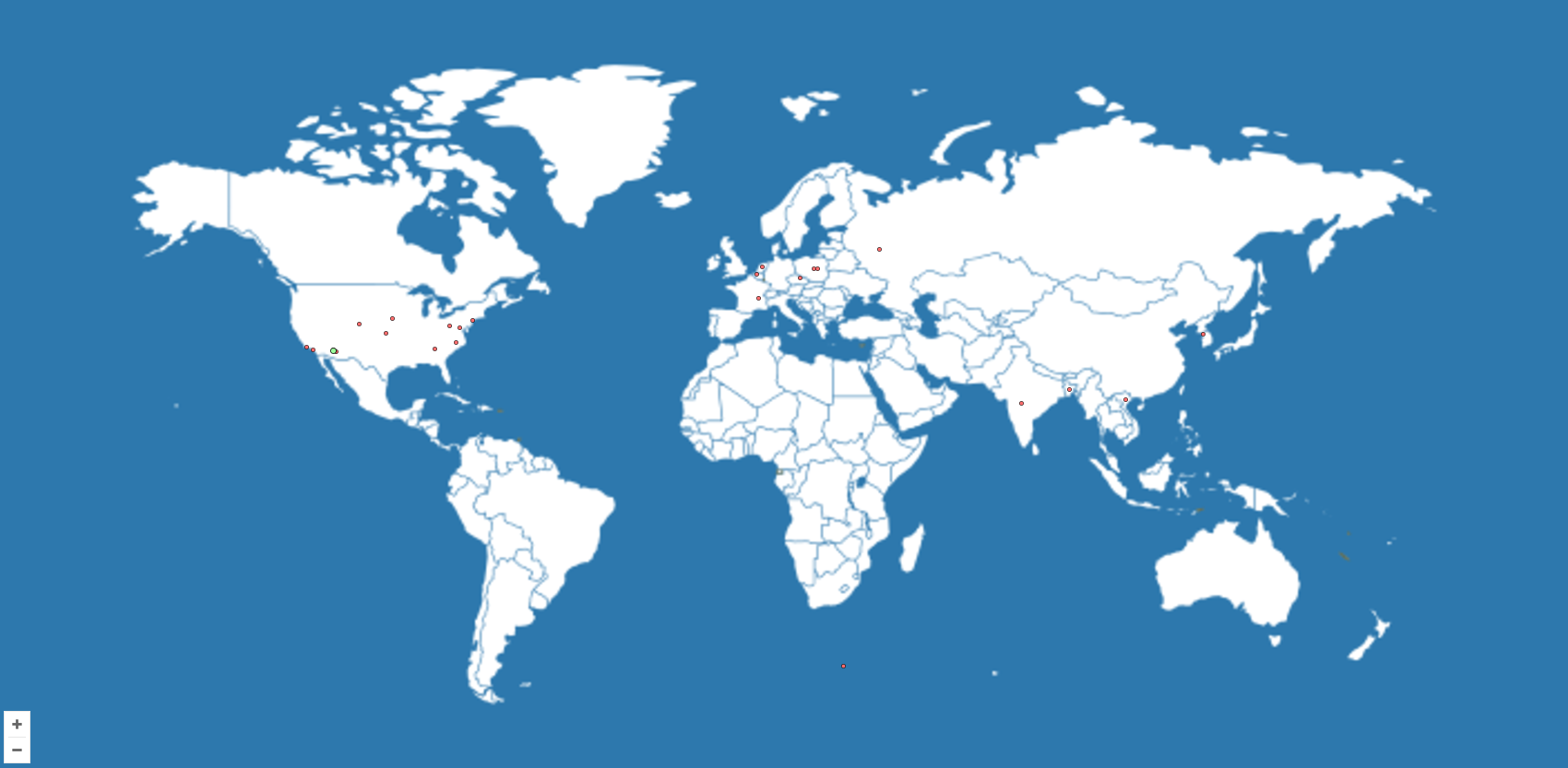


United States Minor Outlying Islands
United States Minor Outlying Islands
Also known as: US Minor Outlying Islands

Head of the United States Government

Federal Administration of Insular Areas


No Weather Information
Pacific Region (Zoomed Out)
Pacific Islands (Zoom In)
Caribbean Region
The United States Minor Outlying Islands are a group of small uninhabited U.S. territories in the Pacific Ocean and Caribbean Sea characterized by coral atolls, reefs, and remote tropical marine environments.
Pacific Region (Zoomed Out)
Pacific Islands (Zoom In)
Caribbean Region
Earth is the third planet from the Sun and the only known world to support life, featuring vast oceans, diverse ecosystems, and complex geological processes.
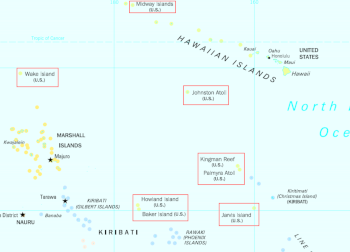
📍 United States Minor Outlying Islands are a collection of small, mostly uninhabited islands and atolls located across the Pacific Ocean and the Caribbean Sea. They are an unincorporated territory of the United States and include islands such as Baker Island, Howland Island, Jarvis Island, Johnston Atoll, Midway Atoll, Wake Island, and Navassa Island, with no land borders and widely dispersed across vast ocean areas.
The United States Minor Outlying Islands’ geography is characterized by low-lying coral atolls, small volcanic islands, and sandy cays, most of which rise only a few meters above sea level. The total land area is relatively small—about 34 square kilometers (13 square miles)—but they are spread over a large maritime zone. These islands typically feature lagoons, coral reefs, and limited vegetation such as grasses and shrubs, while surrounding waters support rich marine ecosystems. Their remote and isolated nature has prevented permanent populations, and they are primarily used for scientific research, wildlife conservation, and, in some cases, military or navigation purposes.
Status

Islands & Atolls

Wake Island
(Military / Airfield – Rotating Personnel)

Midway Atoll
(Wildlife Refuge – Staff Presence)

Palmyra Atoll
(Research Station – Occasional)

Johnston Atoll
(Uninhabited – Former Military)

Baker Island
(Uninhabited)

Howland Island
(Uninhabited)

Jarvis Island
(Uninhabited)

Kingman Reef
(Uninhabited Reef)

Navassa Island
(Uninhabited – Protected)
Road System (Scattered Pacific & Caribbean Atolls Infrastructure)
Drives On: Right (varies by territory use, mostly US-standard)
The US Minor Outlying Islands are unincorporated territories with minimal or no permanent road infrastructure in most locations.
Electrical System (Extremely Limited / US Standard Influence)
Primary Plug Types: Type A & Type B (where applicable)
Most islands use US-standard electrical systems where inhabited or temporarily used.
What is the Internet TLD for the United States Minor Outlying Islands?
A top-level domain (TLD) is the last section of a website address that appears after the final dot.Country-code top-level domains are assigned to territories and islands under ISO standards.
Examples:
.us = United States .um = US Minor Outlying Islands (historical ccTLD) .pr = Puerto Rico
The United States Minor Outlying Islands use:
.um (historical / largely unused today)
What is the ISO Code for the United States Minor Outlying Islands?
ISO country codes come from the international standard ISO 3166 created by the International Organization for Standardization (ISO). The United States Minor Outlying Islands are a collection of small Pacific and Caribbean islands administered by the United States.ISO 3166-1 codes are the two-letter territory codes such as UM. These are called Level-1 ISO codes.
This territory is assigned:
UM
Official ISO territory name:
United States Minor Outlying Islands
Subdivision codes do not have flag emojis.
ISO-2 Code: UM
ISO-3 Code: UMI
ISO Numeric Code: 581
UM  US Minor Outlying Islands
US Minor Outlying Islands Click to Copy Flag
Unicode Flag Code: U+1F1FA U+1F1F2
Click to Copy
Official Motto:
"In God We Trust"
(adopted by Congress and signed into law by President Dwight D. Eisenhower on July 30, 1956. It is commonly displayed on U.S. currency and in public buildings. It replaced the de facto, long-standing motto "E Pluribus Unum" ("Out of many, one")
Other Motto:
"E Pluribus Unum"
(Translated from Latin: "Out of many, one", adopted in 1782 for the Great Seal, this Latin phrase means and represents the union of the original 13 colonies.)
MY BLOG
Below is all of my blogs together, from all of my sites.
Cultural Survival, 🇱🇮 Liechtenstein: Small State, Enduring Identity2026-03-18 20:26:58
A Series on Cultural Survival 4 Throughout history, many nations survived because of size,...
Cultural Survival, 🇩🇪 Germany: Identity Through Fragmentation and Reunification2026-03-18 20:25:25
A Series on Cultural Survival 4 Throughout history, some nations survived conquest. Others endured...
Cultural Survival, 🇦🇹 Austria: From Empire to Identity2026-03-18 20:23:46
A Series on Cultural Survival 4 Throughout history, some nations fought to gain power. Others...
SUBSCRIBE
Subscribe To Our Blog (News)
CONTACT ME
There are a few ways to contact me. Important phone calls and emails will be answered in 24 hours.
Office Address
Located in the USA and Europe
Phone Number
Email Address