


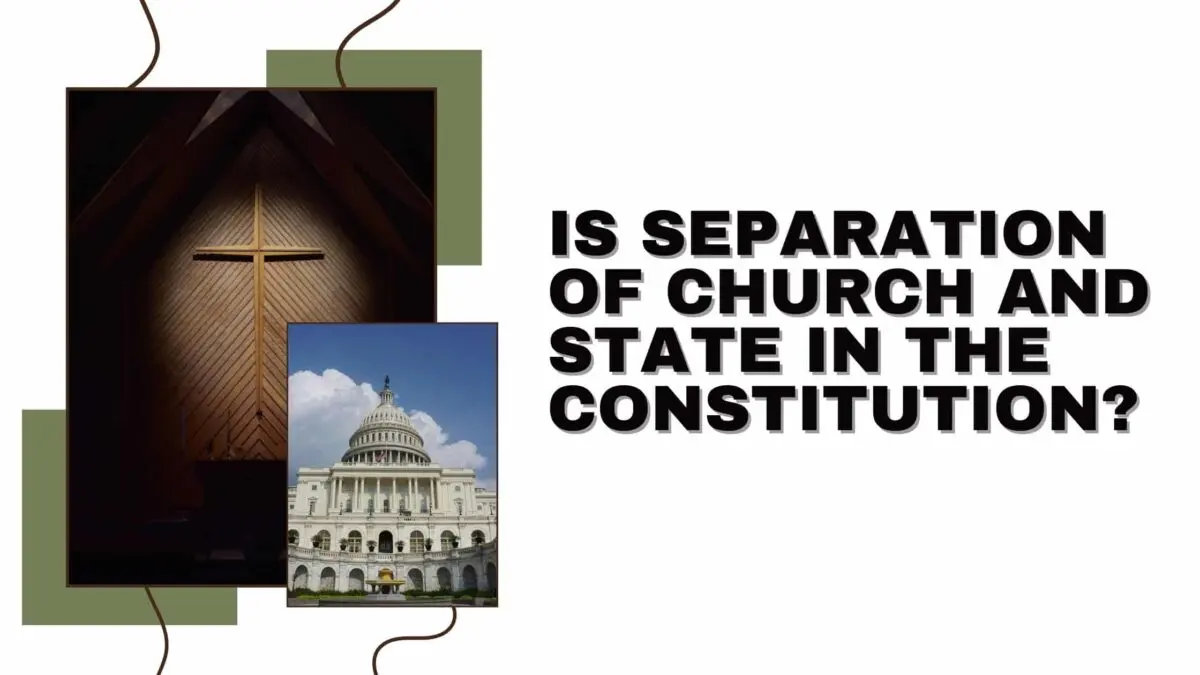
Few phrases in American public life are quoted more confidently — and understood less accurately — than “separation of church and state.”
Today, the phrase is wielded like a constitutional muzzle, aimed almost exclusively at Christians, as if faith itself were a contaminant that must be scrubbed from public discourse. It is invoked not as a legal principle but as a cultural veto: your argument doesn’t count because it comes from faith.
But that is not what the phrase meant when it was written.
It is not how it functioned historically.
And it is not how it has ever been applied consistently.
What we are witnessing is not constitutional fidelity — it is ideological repurposing.
The phrase “separation of church and state” does not appear in the U.S. Constitution. Not once.
It originates from an 1802 private letter written by Thomas Jefferson to the Danbury Baptist Association. The Baptists were not asking Jefferson how to silence themselves; they were asking how to protect themselves.
Their fear was rooted in history. In Europe, state-run churches had persecuted dissenting Christians for centuries. The Baptists wanted assurance that the federal government would never control doctrine, clergy, or conscience.
Jefferson responded by explaining that the First Amendment created “a wall of separation between church and state.” But the direction of the wall mattered.
It was built:
To keep government out of the church
To prevent a national denomination
To protect free exercise, not suppress it
The First Amendment itself could not be clearer:
“Congress shall make no law respecting an establishment of religion, or prohibiting the free exercise thereof.”
This is a restriction on Congress, not believers.
It bans state religion, not religious reasoning.
It protects expression — it does not erase it.
The same generation that ratified this amendment:
Opened congressional sessions with prayer
Appointed chaplains using public funds
Quoted Scripture in political speeches
Taught moral instruction rooted in biblical ethics
They did not see faith and governance as enemies. They saw tyranny as the enemy — and conscience as the safeguard.
The modern interpretation — that faith must remain invisible to be legitimate — would have been unrecognizable to the founders.
One of the most damaging lies in modern political theory is the claim that public life can be value-neutral.
It cannot.
Every society is shaped by answers to ultimate questions:
What is a human being?
Is there objective good and evil?
Where does authority come from?
What limits power?
Those answers don’t disappear when God is removed — they are simply answered differently.
Everyone believes something:
The Christian believes God is the source of truth
The atheist believes there is no transcendent authority
The secularist believes meaning is self-constructed
The humanist believes morality emerges from consensus
The Marxist believes history is driven by power and material struggle
These are not scientific conclusions. They are philosophical commitments.
So when Christianity is excluded from public reasoning, what actually happens is not neutrality — it is replacement. A different belief system takes the throne, while pretending it doesn’t exist.
That belief system still legislates morality.
Still defines justice.
Still punishes dissent.
It just no longer admits where its authority comes from.
No verse is quoted more frequently by people who reject Christianity than:
“Judge not, lest you be judged.” (Matthew 7:1)
It is almost always used as a rhetorical shutdown:
To end moral disagreement
To delegitimize Christian conviction
To demand silence without accountability
But the verse is never quoted honestly.
Jesus continues:
“For with the judgment you pronounce you will be judged…
Why do you see the speck in your brother’s eye, but do not notice the log in your own eye?
First take the log out of your own eye, and then you will see clearly to take the speck out of your brother’s eye.”
Jesus does not forbid judgment.
He forbids hypocrisy.
The goal is clearer judgment, not no judgment.
The Apostle Paul makes this unmistakable in 1 Corinthians 5, rebuking the church for refusing to confront sin:
“Is it not those inside the church whom you are to judge?”
Modern culture lifts one sentence out of Scripture, strips it of context, and then uses it to silence the very worldview it came from — usually by people who deny biblical authority altogether.
That is not biblical interpretation.
It is ideological appropriation.
When transcendent moral authority is removed, societies do not become freer — they become unstable.
Scripture names this pattern repeatedly:
“Woe to those who call evil good and good evil.” (Isaiah 5:20)
“When there is no vision, the people perish.” (Proverbs 29:18)
But this isn’t uniquely biblical insight.
Even Sun Tzu, writing centuries before Christ, understood that a nation’s strength depends on:
Moral cohesion
Shared values
Discipline
Internal unity
A society that loses its moral compass becomes vulnerable — not just to invasion, but to internal collapse.
You don’t need armies when confusion does the work for you.
Karl Marx was not subtle about religion:
“Religion is the opium of the people.”
Christianity posed a threat because it placed authority above the state. Any ideology seeking total control must eliminate rival loyalties — especially to God.
That is why Marxist and socialist regimes consistently followed the same playbook:
Churches controlled or destroyed
Clergy imprisoned or executed
Faith rebranded as dangerous or regressive
The state positioned as moral arbiter
This happened in:
Different flags. Same strategy.
Secularism was never the end goal. It was the gateway.
Saul Alinsky understood something many conservatives ignored: culture precedes law.
In Rules for Radicals, he emphasizes:
Ridicule as a weapon
Moral inversion
Framing opponents as illegitimate
Winning institutions before elections
This is why debates feel impossible today. The goal is not persuasion — it is delegitimization.
Faith is not debated; it is disqualified.
The Seven Mountain framework (articulated by thinkers like Johnny Enlow and Lance Wallnau) is often mischaracterized as domination. It is not.
It begins with a simple reality: every sphere of society will be shaped by someone’s values.
Those spheres are:
Government
Education
Media
Arts & Entertainment
Business
Family
Religion
Withdrawal does not produce neutrality. It produces capture.
Christians are not called to force belief — but they are called to participate, lead, and bear witness.
Salt that stays in the shaker does nothing.
The United States was founded within a Judeo-Christian moral framework — not Islamic jurisprudence, Marxist materialism, or secular relativism.
That does not mean Muslims should be denied civil rights.
It does mean Islamic political theology — which historically fuses religious law and state power — is fundamentally different from America’s founding vision.
Acknowledging that difference is not hatred.
It is clarity.
Pluralism only works when differences are named honestly.
Christians were told:
Stay out of politics
Keep faith private
Morality is subjective
Judgment is unloving
They listened.
The vacuum was filled.
Government expanded.
Speech narrowed.
Morality was enforced — just without God.
History shows this pattern clearly:
When the church retreats, the state advances.
This is not about forcing belief.
It is about refusing silence.
Christianity shaped the moral architecture of the West — imperfectly, but profoundly. To erase that influence is not progress; it is amnesia.
The question now is not whether Christians are allowed to believe.
It is whether they will speak, participate, and lead — or allow others to define the future unchallenged.
Because someone always will.
This post exists to answer predictable questions and objections that arise whenever Christians talk openly about faith, politics, and culture. It’s not written to inflame, but to clarify.
If you haven’t read the main essay yet, start there. This FAQ assumes good faith curiosity—even when we disagree.
No. Explicitly no.
A theocracy is a system where religious authorities rule by force and dissent is criminalized. That is not what I’m advocating—and it is not consistent with Christian theology or American constitutional principles.
What I am arguing for is this:
Christians have the same right as anyone else to bring their moral reasoning into public life
Faith-based arguments should not be disqualified simply because they are faith-based
Participation is not domination
Christian involvement in culture is about witness and responsibility, not coercion.
That interpretation is modern—and historically inaccurate.
The phrase “separation of church and state” comes from a private letter by Thomas Jefferson, not the Constitution. It was meant to protect churches from government control, not to silence religious citizens.
The First Amendment restrains Congress, not conscience.
Preventing a state-sponsored religion is not the same thing as banning moral reasoning shaped by faith.
This verse is almost always quoted without context.
Jesus condemns hypocritical judgment, not moral discernment. In the same passage, He instructs people to examine themselves so that they can judge rightly.
The Apostle Paul goes further, explicitly teaching that moral accountability—especially within the community of faith—is necessary.
Using “judge not” to shut down all moral disagreement is not biblical; it’s rhetorical.
Everyone’s beliefs shape policy—whether they admit it or not.
Laws about life, family, education, speech, economics, and justice all reflect moral assumptions. The only real question is whose assumptions get priority.
Christians are not asking for special privileges. They are asking for equal standing in the public square.
Excluding religious viewpoints doesn’t eliminate belief—it just replaces one worldview with another.
History is precisely why these questions matter.
Totalitarian regimes—across ideologies—consistently suppressed Christianity because it placed moral authority above the state. That pattern is documented, not speculative.
Pointing that out is not fearmongering. It’s pattern recognition.
Warning about historical outcomes is not the same as predicting identical ones—it’s learning from precedent.
Because ideas have consequences.
Political systems don’t emerge in a vacuum; they grow out of philosophical and moral frameworks. Marxism explicitly viewed religion as an obstacle to social control. Secularism often claims neutrality while enforcing its own moral vision.
Understanding these roots helps explain why certain beliefs are marginalized while others are normalized.
This is analysis, not name-calling.
Yes—and true pluralism requires open participation, not selective exclusion.
Pluralism does not mean pretending differences don’t exist. It means allowing competing worldviews to speak, persuade, and coexist under shared legal protections.
Silencing one worldview in the name of tolerance is not pluralism. It’s preference disguised as principle.
Absolutely not.
Civil rights are not dependent on belief. Religious liberty protects everyone, including those who reject religion entirely.
But equal rights do not require equal silence. Disagreement is not discrimination.
A healthy society allows moral debate without treating conviction as violence.
Because withdrawal doesn’t create neutrality—it creates a vacuum.
Every major cultural institution will be shaped by someone’s values:
Government
Education
Media
Business
Family
Arts
Religion
The question isn’t whether Christians should control these spaces, but whether they should abdicate responsibility for them.
Salt that never leaves the shaker changes nothing.
Not power.
Not domination.
Not nostalgia.
The goal is:
Faithful presence
Honest participation
Moral clarity without coercion
Love without silence
Christians aren’t called to win arguments at all costs—but neither are they called to disappear.
If you disagree with these conclusions, that’s okay. Disagreement is part of a free society.
But freedom only survives when people are allowed to speak from what they actually believe—without being told that belief itself disqualifies them.
That’s the conversation worth having.
The United States Constitution, First Amendment
Thomas Jefferson, Letter to the Danbury Baptist Association (1802)
James Madison, Memorial and Remonstrance Against Religious Assessments (1785)
George Washington, Farewell Address (1796)
John Adams, A Defence of the Constitutions of Government of the United States of America
The Holy Bible, ESV / KJV / NIV
Matthew 7
1 Corinthians 5
Isaiah 5
Proverbs 29
Romans 1
Matthew 28
Roger Williams, The Bloudy Tenent of Persecution
Mark David Hall, Did America Have a Christian Founding?
John Witte Jr., Religion and the American Constitutional Experiment
Michael Novak, On Two Wings: Humble Faith and Common Sense at the American Founding
Karl Marx, Critique of Hegel’s Philosophy of Right
Karl Marx & Friedrich Engels, The Communist Manifesto
Hannah Arendt, The Origins of Totalitarianism
Aleksandr Solzhenitsyn, The Gulag Archipelago
Richard Pipes, Communism: A History
Paul Johnson, Modern Times
Orlando Figes, A People’s Tragedy: The Russian Revolution
Frank Dikötter, Mao’s Great Famine
Saul Alinsky, Rules for Radicals
Saul Alinsky, Reveille for Radicals
Os Guinness, The Suicide of a Superpower
Rod Dreher, Live Not By Lies
C.S. Lewis, The Abolition of Man
Dietrich Bonhoeffer, Letters and Papers from Prison
Sun Tzu, The Art of War
Johnny Enlow, The Seven Mountain Prophecy
Lance Wallnau, God’s Chaos Candidate
Francis Schaeffer, How Should We Then Live?
Bernard Lewis, What Went Wrong?
Niall Ferguson, Civilization: The West and the Rest
Samuel P. Huntington, The Clash of Civilizations and the Remaking of World Order
Charles Taylor, A Secular Age
Alasdair MacIntyre, After Virtue
Peter Berger, The Sacred Canopy
Scripture citations are taken from widely used English translations. Historical and philosophical sources are provided for context, not endorsement of every conclusion drawn by their authors.


Your Date and Time

Greg Loucks is a writer, poet, filmmaker, musician, and graphic designer, as well as a creative visionary and faith-driven storyteller working at the intersection of language, meaning, and human connection. Born and raised in Phoenix, Arizona, he has lived in Cincinnati, Ohio; Hot Springs, Arkansas; Williams, Arizona; and Flagstaff, Arizona—each place shaping his perspective, resilience, and creative voice.

United States of America and Europe
Arizona: (928) 563-GREG (4734)
Tennessee: (615) 899-GREG (4734)
Toll-Free: 888-457-GREG (4734)




Comments