






🖊️ Post
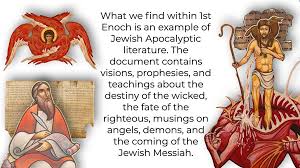
The Book of Enoch: Why an Ancient, Non-Canonical Text Still Haunts Modern Conversations About Angels, Demons, and Power
Few ancient writings generate as much fascination, confusion, and controversy as the Book of Enoch.
It is quoted in the New Testament.
It shaped Jewish and early Christian thought.
It was preserved for centuries outside the Western biblical canon.
And today, it sits at the center of debates about angels, demons, Nephilim, spiritual warfare, and even modern supernatural narratives.
But what is the Book of Enoch really—and what should Christians do with it?
What the Book of Enoch Is (and Is Not)
The Book of Enoch (often called 1 Enoch) is an ancient Jewish apocalyptic text composed between roughly 300 BC and AD 100. It is attributed to Enoch, the great-grandfather of Noah, the man Scripture says:
“Enoch walked with God; then he was no more, because God took him.”
— Genesis 5:24
That mysterious biblical statement fueled generations of speculation—and Enoch expands on it dramatically.
Important clarity:
-
1 Enoch is not part of the Hebrew Bible
-
It is not included in most Christian canons
-
It is considered canonical only in the Ethiopian Orthodox Church
-
It is not Scripture in the same sense as Genesis or the Gospels
But non-canonical does not mean irrelevant.
Why Enoch Still Matters Biblically
The New Testament itself references Enoch explicitly:
“Enoch, the seventh from Adam, prophesied…”
— Jude 1:14
Jude then quotes language found only in 1 Enoch.
This tells us something critical:
Early Jewish and Christian audiences were familiar with Enoch, even if they did not treat it as Scripture.
Think of it like this:
Enoch functioned as theological background material, not doctrine.
The Watchers and Genesis 6
The most famous—and controversial—section of Enoch expands on Genesis 6:1–4, where “the sons of God” take human wives and produce the Nephilim.
Genesis is brief.
Enoch is not.
In Enoch:
-
These beings are called Watchers
-
They descend to Earth in rebellion
-
They teach forbidden knowledge (weapons, sorcery, astrology)
-
Their offspring become violent giants
-
Their actions corrupt humanity
-
Judgment follows
This interpretation was not fringe in antiquity.
Many Second Temple Jews—and some early Christians—read Genesis 6 this way.
Demons in Enoch: Disembodied Spirits
One of Enoch’s most influential ideas is its explanation for demons.
According to Enoch:
-
The Nephilim are destroyed
-
Their spirits remain
-
These spirits roam the earth
-
They seek influence, oppression, and deception
This concept later appears—stripped of Enoch’s narrative detail—in the New Testament worldview.
Jesus casts out demons.
Paul speaks of spiritual powers.
The Gospels assume invisible hostile forces.
Enoch did not invent that worldview—it articulated one already present.
Why the Early Church Didn’t Canonize Enoch
This matters.
The early Church rejected Enoch for several reasons:
-
Pseudonymous authorship
-
Speculative cosmology
-
Excessive angelology
-
Doctrinal ambiguity
In other words:
Enoch explains too much.
Scripture, by contrast, often limits detail intentionally.
That restraint is part of biblical wisdom.
Where Modern Readers Go Wrong
The danger today is not reading Enoch—it’s reading Enoch as Scripture.
Some modern movements:
-
Treat Enoch as secret revelation
-
Build entire doctrines on it
-
Use it to justify speculative cosmology
-
Blend it with conspiracy theories
-
Override clear biblical teaching
That reverses the proper order.
Enoch can illuminate Scripture.
It must never replace it.
Enoch, Spiritual Warfare, and Discernment
Used properly, Enoch helps explain why:
-
The Bible assumes hostile spiritual forces
-
Knowledge can be corruptive
-
Power divorced from obedience leads to destruction
-
God limits revelation for human good
Used improperly, it fuels:
-
Fear-based theology
-
Obsession with demons
-
Endless speculation
-
Distrust of Scripture’s sufficiency
Paul’s warning applies here:
“Do not go beyond what is written.”
— 1 Corinthians 4:6
Aliens, Nephilim, and Modern Mythmaking
Many modern readers try to retrofit Enoch into:
-
UFO narratives
-
Alien mythology
-
Ancient astronaut theories
But this misunderstands both Enoch and Scripture.
Enoch’s worldview is theological, not technological.
Its concern is obedience and rebellion, not spaceships.
The danger isn’t that Enoch supports modern myths—
it’s that modern myths imitate ancient spiritual deception.
What Enoch Ultimately Points To
Despite all its strangeness, Enoch has a surprisingly consistent moral arc:
-
Rebellion leads to judgment
-
Forbidden knowledge corrupts
-
God restrains evil
-
Righteousness matters
-
Judgment is real
Those themes align with Scripture—not replace it.
A Proper Christian Posture Toward Enoch
A mature approach looks like this:
-
Respect it as ancient Jewish literature
-
Learn from its historical context
-
Let it clarify—not dominate—biblical passages
-
Reject speculative excess
-
Anchor doctrine in canonical Scripture
In short:
Enoch can inform your understanding—but Christ must remain your authority.
Final Reflection
The fascination with Enoch reveals something about us.
We want hidden knowledge.
We want cosmic explanations.
We want certainty about unseen powers.
But Scripture reminds us:
“The secret things belong to the Lord our God, but the things revealed belong to us.”
— Deuteronomy 29:29
The Book of Enoch reminds us what happens when curiosity outruns obedience.
And that may be its greatest value of all.
Beyond the First Book: 2 Enoch, 3 Enoch, and the Expansion of Heavenly Speculation
If 1 Enoch explores the fall of heavenly beings and the corruption of the earth, then 2 Enoch and 3 Enoch move in a different—but related—direction.
They are not primarily about rebellion.
They are about ascent, hierarchy, transformation, and heavenly order.
Together, they show how later Jewish thought continued to wrestle with questions Scripture leaves intentionally restrained:
-
What is heaven like?
-
How is authority structured in the unseen realm?
-
What happens to a righteous man taken into God’s presence?
-
How close can a human come to divine glory without becoming divine?
These questions are ancient—and dangerous—if handled without humility.
2 Enoch (Slavonic Enoch): The Journey Through the Heavens
What 2 Enoch Is
2 Enoch, often called Slavonic Enoch, likely dates to the 1st century AD, though the surviving manuscripts are medieval and preserved in Old Church Slavonic.
Unlike 1 Enoch, which focuses on cosmic rebellion, 2 Enoch centers on Enoch’s heavenly ascent.
Here, Enoch:
-
Is taken alive into heaven
-
Travels through multiple heavenly levels
-
Encounters angels, cosmic order, and divine mysteries
-
Receives revelation about creation, time, and judgment
-
Is transformed before returning briefly to earth
Thematic Focus: Order, Not Chaos
2 Enoch is far less interested in fallen angels and far more concerned with cosmic structure.
It emphasizes:
-
God’s absolute sovereignty
-
Angelic obedience
-
Fixed boundaries between heaven and earth
-
The danger of unauthorized knowledge
This is important.
While 1 Enoch shows what happens when angels cross boundaries, 2 Enoch reinforces that boundaries matter.
The Transformation of Enoch
One of the most striking elements of 2 Enoch is Enoch’s transformation:
-
His body is altered
-
His garments change
-
His face shines
-
He is instructed directly by angels
This echoes later biblical moments:
-
Moses’ shining face (Exodus 34)
-
Isaiah’s throne-room vision
-
Paul’s language of transformation
But 2 Enoch presses further—sometimes uncomfortably so—by detailing the process.
This is where discernment is required.
Why 2 Enoch Was Not Canonized
The early Church rejected 2 Enoch for familiar reasons:
-
Over-elaboration
-
Mystical cosmology
-
Speculative detail
-
Lack of apostolic grounding
Scripture gives us glimpses.
2 Enoch gives us tours.
And Scripture consistently warns that not all knowledge is meant for public use.
“He heard inexpressible things, things that no one is permitted to tell.”
— 2 Corinthians 12:4
Paul experienced heaven—and refused to describe it.
That silence matters.
3 Enoch: When Angelology Becomes Hierarchy
What 3 Enoch Is
3 Enoch (also called Sefer Hekhalot) is much later—likely 5th–6th century AD—and reflects early Jewish mystical traditions, particularly Merkabah mysticism.
This text moves decisively away from biblical narrative and into mystical system-building.
Its most famous—and controversial—claim is that Enoch becomes Metatron, a supreme angelic figure.
Metatron and the Problem of Exaltation
In 3 Enoch:
-
Enoch is transformed into Metatron
-
He is given authority
-
He sits near the divine throne
-
He governs angelic orders
This is where Christian theology draws a firm line.
Scripture allows:
-
Exaltation by God
-
Honor for obedience
-
Authority under Christ
Scripture does not allow:
-
Deification of humans
-
Near-equal status with God
-
Angelic mediation replacing Christ
This is why 3 Enoch was never considered compatible with Christian doctrine.
Why These Texts Still Matter
Despite their problems, 2 and 3 Enoch are valuable as warnings.
They show how quickly fascination with the unseen can:
-
Shift from obedience to curiosity
-
Turn reverence into hierarchy obsession
-
Replace covenant with technique
-
Blur the Creator–creature distinction
This is not merely ancient history.
These same patterns appear today in:
-
Mysticism divorced from Scripture
-
Angel-focused spirituality
-
Obsession with ranks, realms, and keys
-
Claims of special access or elevation
The Bible consistently resists this drift.
Spiritual Warfare Without Speculation
One of the great ironies is that Scripture teaches spiritual warfare clearly—without indulging in elaborate cosmology.
Paul tells us:
-
The enemy exists
-
Authority is real
-
Christ is supreme
-
The believer stands firm through truth, righteousness, and faith
He does not give maps of heaven.
“For we walk by faith, not by sight.”
— 2 Corinthians 5:7
2 and 3 Enoch remind us what happens when sight becomes the obsession.
A Balanced Christian Reading
A wise posture toward 2 and 3 Enoch looks like this:
-
Read them as historical theology, not revelation
-
Recognize their influence on later mysticism
-
Learn where boundaries were crossed
-
Let Scripture remain the measuring rod
-
Keep Christ—not angels—at the center
The New Testament is deliberately restrained because restraint protects worship.
Final Reflection
If 1 Enoch warns us about rebellion,
2 Enoch warns us about curiosity,
and 3 Enoch warns us about exaltation.
All three ultimately point to the same truth:
The unseen realm is real—but it is not ours to control, map, or master.
The gospel does not call believers to secret knowledge.
It calls us to faithfulness.
And that, Scripture insists, is enough.
1 Enoch and the Book of Revelation: Similar Imagery, Very Different Authority
At first glance, the Book of Enoch and the Book of Revelation can feel uncannily similar.
Both describe:
-
Heavenly visions
-
Angels and judgment
-
Cosmic conflict
-
Thrones, fire, and glory
-
The downfall of evil powers
Because of this overlap, many readers assume the two books are doing the same thing—or worse, that Revelation depends on Enoch.
It doesn’t.
Understanding why they sound similar but function differently is essential for spiritual discernment.
Shared Worldview: Second Temple Jewish Apocalyptic Language
Both 1 Enoch and Revelation emerge from what scholars call apocalyptic literature—a genre common in Jewish thought between 300 BC and AD 100.
This genre uses:
-
Symbolism instead of plain description
-
Visions instead of narratives
-
Cosmic imagery to describe earthly and spiritual realities
That shared language explains overlap without implying equal authority.
Jesus, Paul, and John all spoke into a culture already familiar with this imagery.
Where 1 Enoch and Revelation Appear Similar
1. Heavenly Courts and Thrones
1 Enoch describes God seated in glory, surrounded by angelic beings.
Revelation shows a throne room with elders, living creatures, and worship.
But here’s the difference:
-
In Enoch, angels dominate the scene
-
In Revelation, the Lamb is central
“Worthy is the Lamb who was slain.” (Revelation 5:12)
Christ—not angels—anchors the vision.
2. Judgment of Evil Powers
Both books describe judgment on rebellious beings.
-
1 Enoch focuses heavily on fallen angels (Watchers)
-
Revelation focuses on Satan, the Beast, Babylon, and human systems aligned with evil
Enoch looks backward to pre-Flood rebellion.
Revelation looks forward to final restoration.
3. Cosmic Warfare
Both depict the universe as morally contested.
But Revelation is explicit about Christ’s victory, while Enoch is more descriptive than redemptive.
“Now have come the salvation and the power and the kingdom of our God.”
— Revelation 12:10
Enoch diagnoses the problem.
Revelation declares the cure.
The Most Important Difference: Authority and Revelation
1 Enoch Explains — Revelation Reveals
1 Enoch:
-
Expands on Genesis 6
-
Speculates about angelic hierarchies
-
Fills in narrative gaps Scripture leaves open
Revelation:
-
Was given directly “by Jesus Christ” (Revelation 1:1)
-
Was written by an apostolic witness
-
Was recognized early as inspired Scripture
-
Centers entirely on Christ’s lordship
Enoch answers curiosity.
Revelation calls for repentance, endurance, and worship.
The Role of Angels: Assistants vs. Focus
This distinction cannot be overstated.
In 1 Enoch:
-
Angels teach
-
Angels explain
-
Angels dominate the narrative
In Revelation:
-
Angels serve
-
Angels deliver messages
-
Angels explicitly refuse worship
“Do not do that! I am a fellow servant.”
— Revelation 19:10
Revelation actively guards against angel-centered spirituality.
Speculation vs. Restraint
1 Enoch is expansive.
Revelation is controlled.
John is shown astonishing things—but is also told:
“Seal up what the seven thunders have said and do not write it down.”
— Revelation 10:4
That restraint is theological, not accidental.
Revelation reveals only what the Church needs to remain faithful under pressure.
Why Revelation Was Canonized and Enoch Was Not
The early Church recognized clear differences:
| Criteria | 1 Enoch | Revelation |
|---|---|---|
| Apostolic authority | ❌ | ✅ |
| Christ-centered | Partial | Absolute |
| Doctrinal clarity | Mixed | Consistent |
| Speculation level | High | Restrained |
| Use in worship | Rare | Widespread |
Revelation survived intense scrutiny because it aligned with:
-
The gospel
-
Apostolic teaching
-
The rule of faith
-
The lived experience of the early Church
Enoch did not.
When Modern Readers Confuse the Two
Problems arise when:
-
Enoch is treated as secret revelation
-
Revelation is read through Enoch instead of Scripture
-
Speculation replaces obedience
-
Fear replaces hope
Ironically, Revelation warns against this exact impulse.
“Blessed is the one who keeps the words of this prophecy.”
— Revelation 22:7
Not the one who decodes every symbol—but the one who remains faithful.
Theological Bottom Line
1 Enoch helps us understand how ancient Jews thought about the unseen world.
Revelation tells us who rules it.
Enoch asks: What went wrong?
Revelation answers: Who makes it right?
And the answer is always the same:
“The kingdom of the world has become the kingdom of our Lord and of His Christ.”
— Revelation 11:15
Final Reflection
If 1 Enoch expands the imagination,
Revelation anchors the soul.
If Enoch fuels curiosity,
Revelation demands allegiance.
If Enoch explores the shadows,
Revelation reveals the Light.
And Scripture leaves no ambiguity about which one the Church is meant to follow.
Related Articles
Search
Subscribe
Donate


Your Statistics
For the care and safety of this prayer space, we gently record the time and location of each visit. This helps us protect sincerity while preserving anonymity.
Your Date and Time
IP Addres:
216.73.216.149
System
- OS Linux n
- PHP 8.4.17
- MySQLi 10.6.25-MariaDB-log
- Time 22:26
- Caching Disabled
- Gzip Disabled
- Users 17
- Articles 38
- Articles View Hits 2904
Website Visitors Map

About Greg Loucks
Greg Loucks is a writer, poet, filmmaker, musician, and graphic designer, as well as a creative visionary and faith-driven storyteller working at the intersection of language, meaning, and human connection. Born and raised in Phoenix, Arizona, he has lived in Cincinnati, Ohio; Hot Springs, Arkansas; Williams, Arizona; and Flagstaff, Arizona—each place shaping his perspective, resilience, and creative voice.

Address:
United States of America and Europe
Phone Numbers:
Arizona: (928) 563-GREG (4734)
Tennessee: (615) 899-GREG (4734)
Toll-Free: 888-457-GREG (4734)

Comments